Français
Turnkey solar installation: the complete process explained
“Turnkey”, everyone promises it. But in practical terms, what happens between the day you request a quote and the day your meter starts slowing down? Here is the complete process, step by step, with actual lead times, prices, and the short list of what will be required from you. Spoiler: almost nothing.
What “turnkey” really means
A turnkey installation is a simple contract: you choose the power and budget, and everything else is taken care of. The assessment of your roof, system sizing, filing the declaration with the local council, Enedis grid connection, installation by a certified installer, compliance checks, and commissioning. You have a single point of contact from start to finish, and the approved quote is the final price.
This guide describes the process as we carry it out in our turnkey offer — but these steps apply to any serious project, whether with us or elsewhere. You will know what a normal process looks like, and therefore also be able to spot what is not.
The 7 steps, from your first call to your first lower bill
| Step | What happens | What is required from you |
|---|---|---|
| 1. Consumption assessment | Analysis of your bills and habits, remotely | A recent electricity bill |
| 2. System sizing & quote | Proposal sized according to your actual consumption, with a detailed fixed price | Approve it — or ask all your questions |
| 3. Technical visit | An expert checks the roof, electrical panel, and access on site | Be present for one hour |
| 4. Administrative procedures | Prior declaration to the local council, Enedis / EDF OA grid connection application | Nothing — everything is taken care of |
| 5. Installation | Installation by a certified RGE QualiPV professional, in 1 to 3 days | Access to the property |
| 6. Checks & commissioning | Compliance checks, activation, and monitoring configuration | Nothing |
| 7. Monitoring | Production app and an available point of contact after installation | Enjoy it |
Across the 7 steps, your active participation comes down to: one bill, one signature, one hour of your time, and access on the installation day. Everything else is our job.
How long does it take between the quote and commissioning?
This is the question we are asked during every assessment. The installation itself is short — 1 to 3 days — but the overall schedule mainly depends on administrative lead times: the local council's application review takes one month, and the Enedis connection follows its own timetable. In practice, allow 2 to 3 months between signing the quote and commissioning for a straightforward project. A well-managed process is above all one where these procedures are launched immediately and in parallel — and that is precisely what we take care of.
What power output is right for your home?
Proper system sizing starts with your consumption, never with the surface area of your roof — especially since the 2026 reform, under which each surplus kWh is sold for 1 cent. The guidelines:
3 kWp (approximately 6 panels): moderate consumption, an ideal first step, and our entry-level option at €6,490 installed. 6 kWp (approximately 12 panels): the most popular size, covering a large share of a family household's consumption. 10 kWp: a large home, high consumption, or an electric vehicle project. And if you use a lot of electricity in the evening, adding a battery changes the equation — our battery guide explains this calculation in detail, with the figures to back it up.
The quote: the document that tells you everything
A serious solar quote is precise and firm. It details the exact equipment (brands and models, not “high-efficiency panels”), the power output, installation, included procedures, and a final price that will not change during the work. Beware of vague quotes, “valid today only” discounts, and wildly optimistic profitability promises: these are the three hallmarks of providers to avoid. We will devote an entire guide to reading a quote line by line — in the meantime, one rule is enough: if it is not written down, it does not exist.
RGE, QualiPV, Consuel: what these acronyms guarantee for you
Three acronyms come up everywhere; here is what they mean from your perspective. RGE QualiPV: the installer is certified for photovoltaic systems, trained, and audited — this is the standard we require from all our partner installers, coordinated by Mon Poseur Énergie. Consuel: the organisation that certifies the electrical compliance of the installation before grid connection — your assurance that everything meets the standards. You do not need to take any steps to obtain it: it is part of the process. The absence of an accreditation, however, should alert you.
Installation day at your home: what to expect
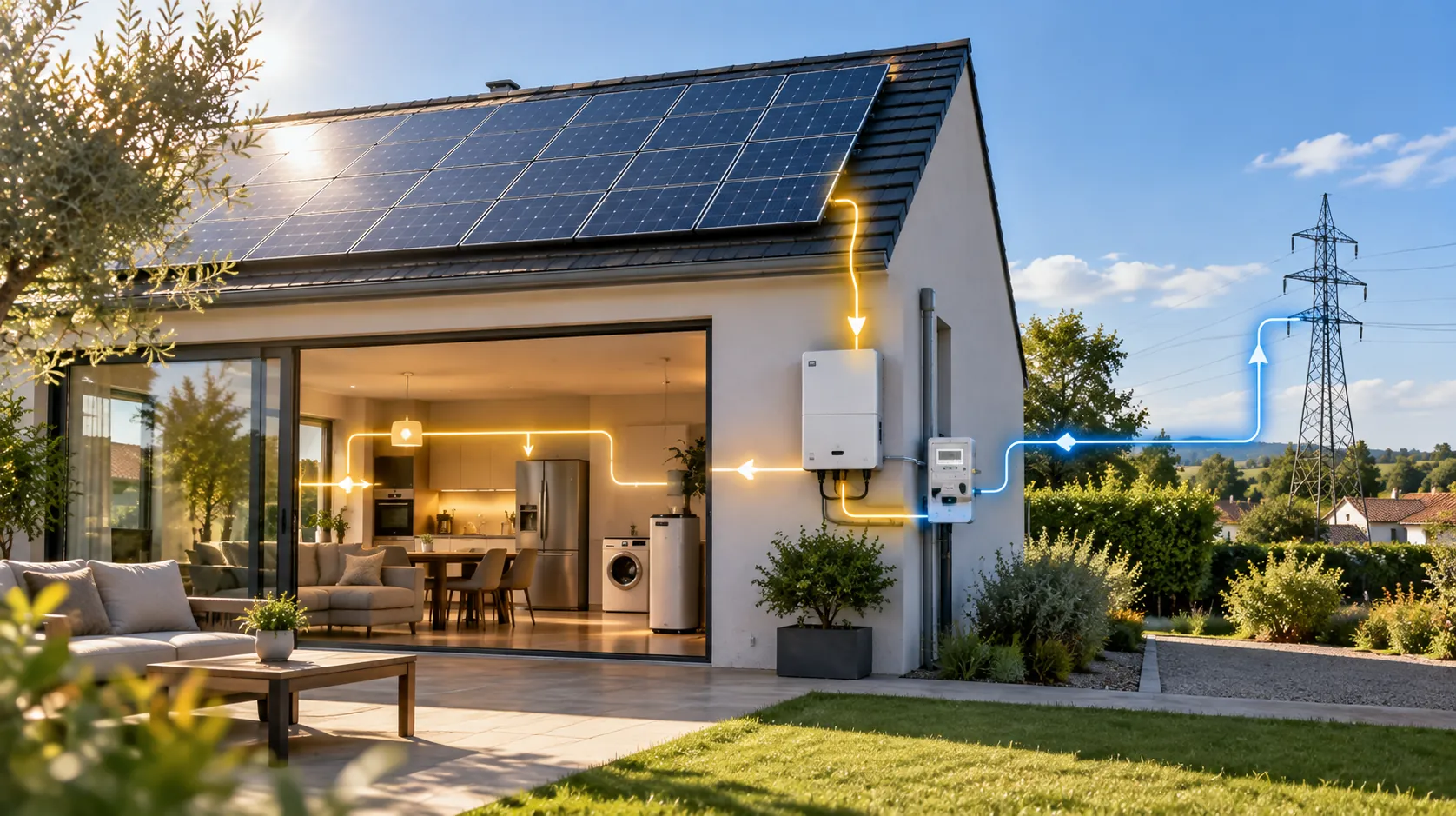
The team arrives in the morning, protects the surrounding areas, installs the mounting systems and then the panels, installs the inverter (and the battery where applicable) near your electrical panel, wires and tests everything. A standard residential installation takes one day; allow two to three days with a battery or a complex roof. You do not need to take a full day off work — access is all that is required. At the end of the work, we show you the monitoring app and answer your questions. That same evening, you can view your production in real time.
How much does it cost in 2026?
Our turnkey offers, supplied and installed, range from €6,490 for 3 kWp to €16,490 for 10 kWp with a 15 kWh battery — the details of the six configurations are on the offer page. In terms of profitability, a properly sized installation with energy storage saves €1,100 to €1,300 per year in the south, for a return on investment of 10 to 12 years and equipment covered by a warranty well beyond that period. The complete calculation is in our 2026 profitability guide.
Your process starts with a free assessment. It does not commit you to anything.
Book my free assessment 04 49 42 00 98Frequently asked questions
Is planning permission required for solar panels?
For a roof installation, a prior declaration to the local council is sufficient in the vast majority of cases — and we file it for you. Protected areas (near a listed historic monument or classified site) sometimes require an additional opinion; this is checked during the assessment.
What happens if my roof does not face due south?
East- or west-facing roofs work very well: the loss is limited to 15–20% of production, often offset by appropriate system sizing. An east/west orientation even produces energy more evenly throughout the day, which promotes self-consumption. Only a due-north orientation is not recommended.
Can the quote price increase during the project?
Not with us: the approved quote is the final price, unless you request a change. That is the benefit of the technical visit before the work begins — surprises are identified beforehand, not invoiced afterwards.
Who takes care of the grid connection and paperwork?
We do. The declaration to the local council, Enedis application, EDF OA contract for surplus injection, and certificate of compliance: all the administrative procedures are included in the offer. Your only contribution is a signature.
Will I be on my own after installation?
No. You keep access to the monitoring app, a reachable point of contact, and our guides for living with your installation: EDF subscription, maintenance, and reading your production. Commissioning is a beginning, not an end.
Prices incl. VAT, supplied and installed, valid for the standard configurations of the turnkey offer (July 2026); the final price depends on the roof and the project configuration. Administrative lead times are provided for guidance based on observed practices. Article updated in July 2026.