Français
2026 feed-in tariff: sell your surplus or use it all yourself?
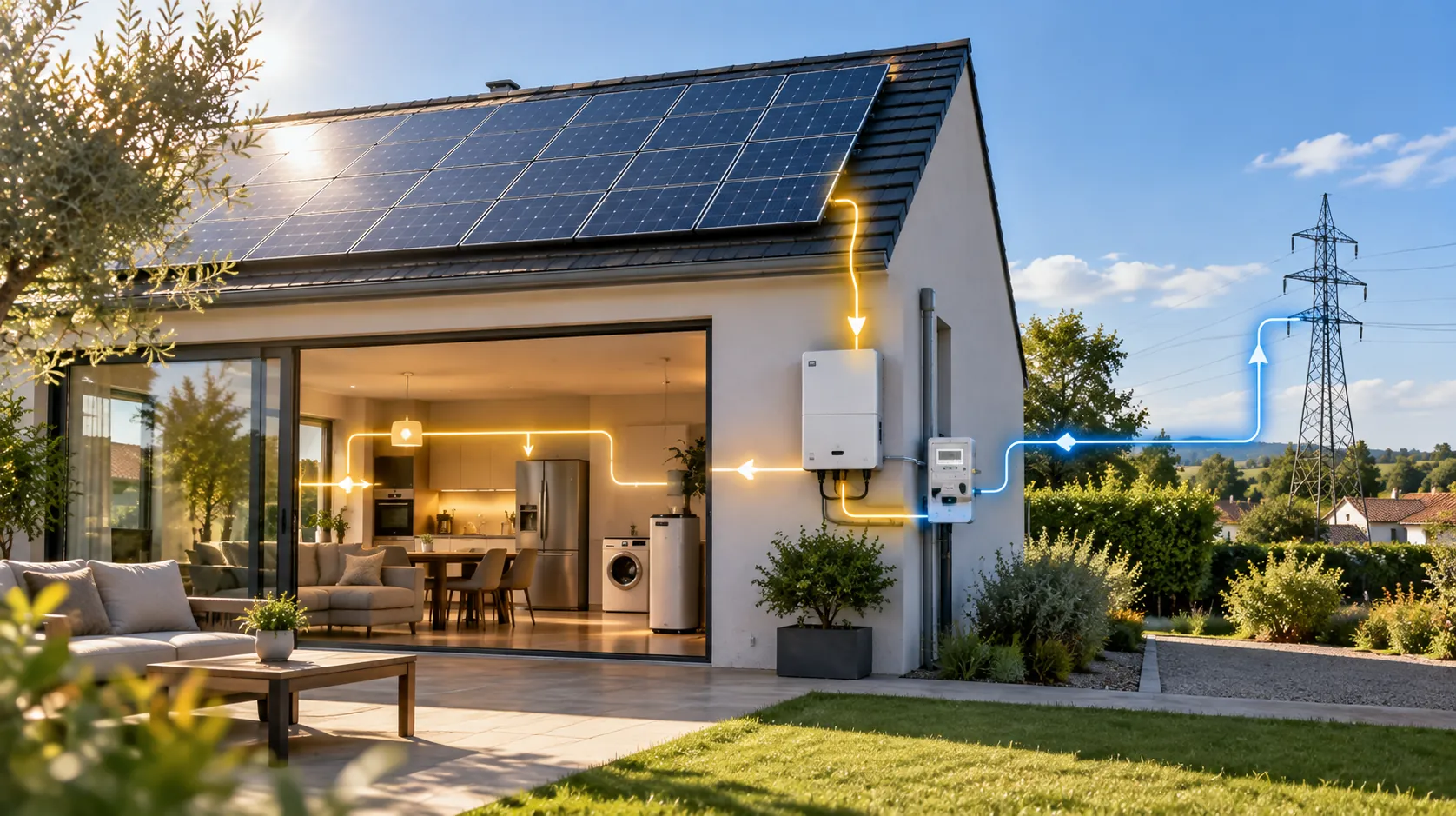
For fifteen years, “selling your electricity” was solar power’s star selling point. In 2026, the question deserves a straightforward answer: the outcome is clear. Surplus electricity is bought at 1.1 euro cents per kWh, total feed-in is no longer available to residential installations — and yet, you still need to sign the feed-in contract. Explanations, with the figures to back them up.
The 2026 figures, straight to the point
Since the reform applicable from 5 June 2026, surplus from self-consumption installations (up to 100 kWp) is bought at 1.1 euro cents per kWh under a 20-year EDF OA contract. The self-consumption bonus has been abolished. And for residential installations up to 9 kWp, total feed-in has no longer been offered since March 2025: the “I sell everything” option has simply disappeared from the menu.
The kWh you avoid buying is worth €0.1940 (Tarif Bleu, first half of 2026). The kWh you sell is worth €0.011. Ratio: ×18. The entire 2026 solar strategy comes down to these two figures.
What selling really earns: a worked example
Let’s take our reference installation: 6 kWp in the south, producing 8 400 kWh per year. Without a battery, 45% is self-consumed — the remaining 55%, or 4 620 kWh, is sent to the grid. At 1.1 euro cents, this surplus generates… around €51 per year. Less than a tank of fuel. The same 4 620 kWh, if consumed on site, would be worth nearly €900 in avoided purchases. That is the whole point:
| What happens to your surplus (6 kWp south, 4 620 kWh) | Annual value |
|---|---|
| Sold to the grid (OA contract, 1.1 c€/kWh) | ≈ €51 |
| Stored in a battery and then used in the evening (at €0.1940/kWh avoided) | up to ≈ €900 depending on the share recovered |
| Shifted through your usage (washing machine, water heater during the day) | +10 to 15 self-consumption percentage points, free of charge |
In practice, a correctly sized battery recovers most of this potential: this is the famous increase from €784 to €1 245 in annual savings detailed in our guide what are the real savings for each user profile — and the test with or without a battery in 5 questions tells you whether it suits your profile.
So why sign the feed-in contract anyway?
Because even an optimised installation always produces some residual surplus — those beautiful Sundays in June when the battery is full at 2 p.m. and the house is empty. This surplus exists anyway: it may as well be paid for rather than given away. The EDF OA contract is free, with no volume commitment, and signing it is one of the procedures we handle as part of our turnkey service. The rule is simple: sign the contract, but never build your project around it. It is small change, not an income.
The 3 consequences for your project
1. We size the system according to consumption, never the roof. Every panel beyond your needs produces electricity worth 1.1 euro cents. The right target: 70 to 90% of your annual consumption — the complete method is in how many panels your home needs.
2. For most households that are away during the day, the battery has become the priority investment for profitability. Its principle is unique in the home: it turns 1.1 euro cents into 19.4 euro cents, kWh after kWh — a gain that depends on your consumption profile, the capacity selected and its price. Sizing takes 5 minutes with our profile-based method.
3. Your habits are worth money. Shifting washing machine, dishwasher and water heater use to production hours means gaining 10 to 15 self-consumption percentage points without spending a euro — the equivalent of a small battery, provided by your timer. And while you are adjusting the settings, check that your electricity plan is still the right one with solar panels — the Base option, off-peak hours and subscribed power should be reviewed after installation.
A word on “why” (to understand, not to regret)
This is not a punishment for solar power: it is the result of its success. At midday, France now produces so much solar electricity that its market value collapses during those hours — sometimes falling to negative prices. The feed-in tariff has aligned with this reality. The lesson to take from this article is the same throughout: midday electricity is worth little on the grid, but it is still worth 19.4 euro cents in your home. The aim is to keep it there.
Beware of outdated content: many online articles and calculators still use pre-reform feed-in tariffs (10 to 13 euro cents) or promise the self-consumption bonus — which has been abolished. Any profitability calculation that includes significant feed-in revenue is, in 2026, incorrect.
Your project, calculated using the actual 2026 tariffs — not yesterday’s rates.
Book my free assessment 04 49 42 00 98Frequently asked questions
Is the EDF OA contract mandatory?
No — you can let your surplus go without payment (declared free injection). But the contract is free and comes with no constraints: you may as well recover those few dozen euros. The only real mistake would be sizing your installation to maximise this income.
I signed my feed-in contract before the reform: will my tariff change?
No: EDF OA contracts guarantee the tariff in force when they were signed for their entire 20-year term. If you signed at 13 euro cents, you remain at 13 euro cents — the reform only applies to new contracts.
Is total feed-in still available?
No longer for residential installations: since March 2025, installations up to 9 kWp can no longer opt for total feed-in. The model remains available for large roofs (agricultural and industrial), which follow a different investment logic — not the logic of residential solar power.
Can I sell my surplus to a buyer other than EDF OA?
Alternative offers exist (aggregators and suppliers offering their own feed-in schemes), sometimes at slightly better rates. But the order of magnitude remains that of the wholesale market at midday — a few cents at best. No feed-in offer competes with self-consumed electricity: compare if you like, but the strategy does not change.
What about a virtual battery that “stores” my surplus?
This is a subscription that records your surplus so it can be deducted from your purchases later — attractive on paper, but subscription fees and the conditions (taxes on returned kWh, in particular) greatly reduce its appeal compared with a physical battery since the reform. We will soon publish a full comparison.
Tariffs: surplus feed-in at 1.1 c€/kWh excl. VAT for self-consumption installations up to 100 kWp (order applicable from 5 June 2026, 20-year EDF OA contracts); Tarif Bleu EDF Base option €0.1940/kWh incl. VAT (first half of 2026); abolition of the self-consumption bonus and end of total feed-in ≤ 9 kWp (March 2025). Example 6 kWp: production 8 400 kWh/year, southern France. Official sources: French Energy Regulatory Commission (CRE) · Service-Public.fr · EDF Obligation d'Achat — the feed-in tariff is set by tariff orders and revised quarterly. Article updated in July 2026.