Français
Which EDF tariff should you choose once your solar panels have been installed?
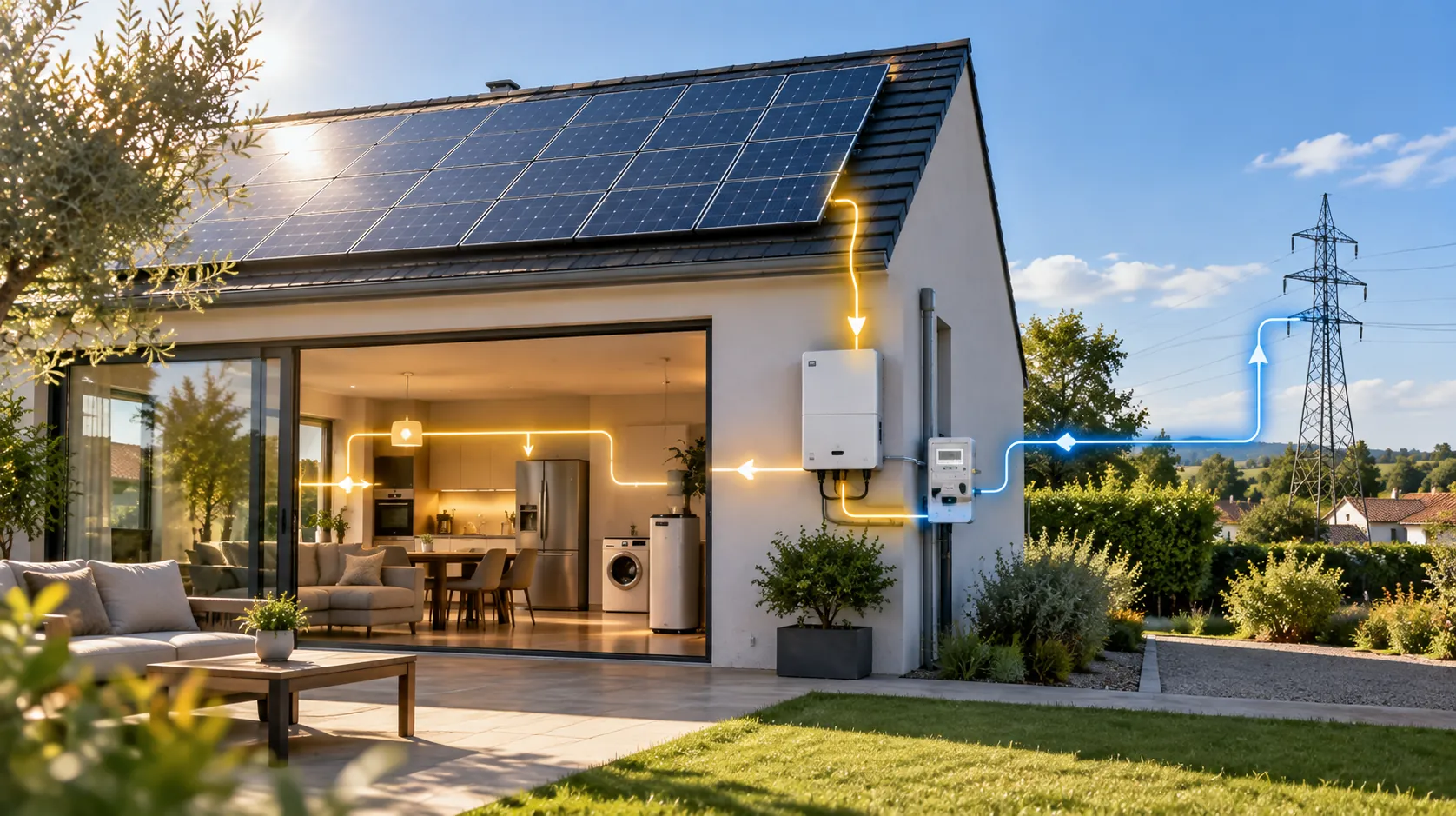
Your panels generate electricity and your bill goes down — but your electricity contract dates from before the installation. Two settings deserve a review: your subscribed power and your tariff option (Base or off-peak hours). And the timing is right: the major off-peak hours reform, currently underway until 2027, is changing the rules — in a way that is generally favourable to solar-powered homes. Here is how to decide, without a spreadsheet.
First, a distinction that avoids confusion
Your electricity arrangements now involve two independent contracts. The supply contract (with EDF or any other electricity supplier — everything in this guide applies to both): this is the one we examine here, covering the kWh you still purchase. And the EDF OA contract, which buys your surplus at the 2026 solar surplus feed-in tariff: that contract is separate, signed for 20 years, and does not change — you can switch supplier freely without affecting it. In other words, optimising your tariff never puts your installation at risk.
Setting 1: subscribed power (kVA)
Many households have a 9 kVA supply “as a precaution”, even though 6 would be enough. Each power band costs a few dozen euros per year in subscription fees — a simple saving, but one that should be decided based on facts, not intuition. The important point: your panels do not reduce your evening peak demand (oven + hobs + washing machine at 7 p.m., when production is zero); a battery, on the other hand, can shave these peaks.
The reliable method: your Linky meter records the maximum power reached each day (visible on the meter display or in your Enedis account). Look at a winter month: if your peak never exceeds 5 kVA, switching from 9 to 6 is risk-free. If it comes close to the limit, stay with your current level — a subscription that is too low means a circuit breaker tripping at the worst possible time just to save three euros a month.
Setting 2: Base or off-peak hours? The logic has changed twice
First change: your panels. The off-peak-hours option used to be worthwhile because of the difference between cheap electricity at night and expensive electricity during the day — but your daytime electricity is now largely free, generated on your roof. The benefit of off-peak hours is limited to what you still import at night.
Second change: the national off-peak hours reform, launched at the end of 2025 and being rolled out extensively until the end of 2027. In summer, some off-peak hours are moving to the afternoon (within the 11 a.m. – 5 p.m. period), precisely when national solar production — and yours — is at its highest. For an equipped home, these afternoon off-peak hours are largely redundant: you are already buying almost nothing during those hours. Your exact time slots are assigned locally (Linky display, “+” button, or your customer account), and your supplier must notify you at least one month before any change.
The post-reform rule of thumb: your residual imports are concentrated in the evening and on winter nights. The off-peak-hours option is only worthwhile if a significant share of these imports falls within off-peak night hours — typically for an electric vehicle or hot-water tank that charges at night.
The verdict by profile
| Your situation | Recommended option | Why |
|---|---|---|
| Panels without a battery, daytime occupancy | Base, most often | Your imports are scattered (evenings, winter): the simplicity of Base outweighs an off-peak-hours difference that has become marginal |
| Panels + battery | Base, except in special cases | The battery already covers your evenings; there are few imports left to optimise, mainly in winter — which Base handles without restrictions |
| Electric vehicle charged at night | Off-peak hours | Night-time charging is the ideal use case for off-peak hours: high volume, exactly within the off-peak window — the tariff difference works to its full potential |
| Hot-water tank controlled by the off-peak signal | Off-peak hours possible — with a hidden bonus | If your new off-peak hours fall in the afternoon, your tank will heat… during your solar production. The reform does for free what smart control would charge for |
The 30-minute method, once a year
There is no need for a complicated simulator. Your monitoring app and Enedis account show your imported kWh hour by hour. Add them up over the last 12 months: how many imports fall within your off-peak periods? Then compare two totals — (off-peak imports × off-peak tariff + peak imports × peak tariff + off-peak subscription) against (total imports × Base tariff + Base subscription). The lower one wins. Useful rule of thumb: the off-peak-hours option costs more in subscription fees and has more expensive peak hours — a surcharge that the difference between current peak/off-peak tariffs generally only offsets once more than 25 to 30% of imports occur during off-peak hours. Below that, Base practically always wins; your 12-month calculation will decide. Repeat the exercise every year: your habits change, and so does the reform.
And keep things in perspective: on a bill already reduced by your panels, the difference between the two options amounts to a few dozen euros per year — worth taking, but insignificant compared with the value of gaining one percentage point of self-consumption. The order of priorities remains: generate, self-consume, then optimise the contract — in that order. The first two levers are quantified in our guide what real savings can you achieve for each profile?.
Frequently asked questions
Can I switch electricity supplier with solar panels?
Yes, freely and without affecting your installation: the EDF OA contract that buys your surplus is independent of your supply contract. You can compare offers like any other household — your surplus will continue to be purchased under exactly the same conditions.
Who decides my new off-peak time slots?
They are assigned by supply point according to local network constraints — two neighbours may have different time slots. You can find them on your Linky display (“+” button), in your customer account or on your bill, and your supplier must notify you at least one month before any change.
Should I switch to Base immediately after my panels are installed?
No — wait until you have 6 to 12 months of actual import data, then perform the 30-minute calculation. Changing options is free and reversible with most suppliers, but it is better to decide based on your figures rather than an average.
Can reducing my subscribed power cause the circuit breaker to trip?
Yes, if your actual peak exceeds the new limit — hence the method: check your maximum power levels over a winter month (Linky or Enedis account) before reducing them. A margin of 1 kVA between your recorded peak and your subscribed power is a good safeguard.
Are dynamic pricing offers worthwhile with solar panels?
They can be worthwhile for highly controllable profiles (battery + electric vehicle + automated management), but they add complexity and price risk. For most solar households, the priority remains: maximise self-consumption first, then make the contract more sophisticated — and only if your data justifies it.
Off-peak hours reform: CRE deliberation (TURPE framework), rollout launched on 1 November 2025, first phase completed in June 2026, generalisation planned by the end of 2027 with seasonal time slots (off-peak hours partly in the afternoon, 11 a.m. – 5 p.m., from 1 April to 31 October). Time slots assigned locally by Enedis. Base/off-peak tariff differences: consult your supplier's current tariffs. Official sources: Commission de régulation de l'énergie (CRE) · Enedis · Service-Public.fr. Article updated in July 2026.