Français
Plug & Play Solar Kit: The Complete Beginner's Guide
Generate your own electricity without construction work, an electrician or administrative paperwork: that is exactly what a plug & play solar kit makes possible. You set it up, plug it into a socket, and it generates power — in 10 minutes, start to finish. Here is everything you need to know before getting started: the law, location, battery, budget and actual savings.
What exactly is a plug & play kit?
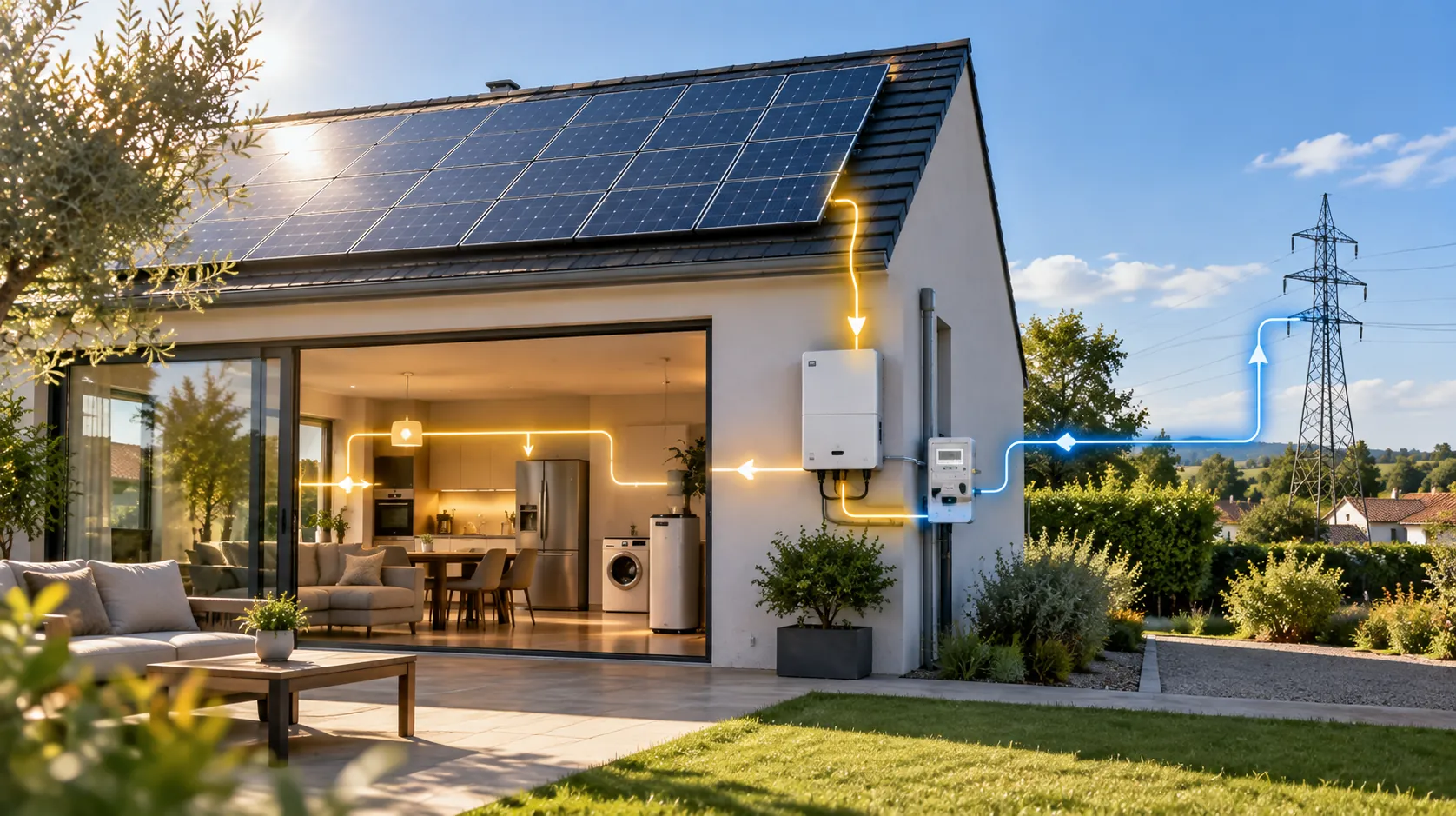
One or two solar panels, a small box that converts their output into household electricity, and a plug. That's it. The kit plugs into a standard socket in your home, and the electricity generated directly powers your appliances: the refrigerator, internet router, freezer — everything that continuously consumes power in your home uses your solar energy first, before drawing from the grid.
The difference from a conventional installation comes down to three things that are not needed: no construction work (nothing is attached to your roof), no electrician (the socket is enough), and no Consuel certification or grid connection application. It is solar energy made as simple as a household appliance.
Is it legal? Yes — and simpler than you think
This is the first question, and the answer is reassuring. A plug & play kit is completely legal in France. The only formality is a free online declaration to Enedis, which takes a few minutes — our guides walk you through it step by step, and that's all.
Three specific situations, three short answers. Tenant? You can install a kit placed on the ground, on a terrace or on a balcony without the owner's permission, since nothing is modified in the home — only a façade mounting system requires their approval. Condominium? A kit placed on your balcony falls within your private use; a visible façade mounting system may require approval from the condominium association. Insurance? In most cases, simply notifying your home insurer is sufficient. We will dedicate a detailed guide to each of these situations.
Where to install it: balcony, terrace, garden or flat roof
Plug & play works anywhere there is sunlight and a socket within extension-cable range. On the ground in the garden with tilted supports, on a terrace, attached to a balcony railing, or placed on a flat roof using weighted ballast trays. The ideal orientation remains south, but east or west work very well too — you lose around 15 to 20% of production, not half as is sometimes claimed.
A simple guideline: two panels take up approximately 5 m². If you have this sunlit area between 11 a.m. and 4 p.m., you have what you need.
What can a kit power? A typical day
A 1000 W kit produces between 1 300 and 1 450 kWh per year, depending on the region. To make this concrete: during the day, it covers what industry professionals call your home's “base load” — everything that continuously consumes power without you thinking about it:
| Your daytime appliances | Consumption | Covered by a 1000 W kit? |
|---|---|---|
| Refrigerator + freezer | ~150 W continuously | Yes, easily |
| Internet router, standby devices and chargers | ~50–80 W | Yes |
| Washing machine or dishwasher (daytime cycle) | ~800–1200 W during the cycle | Yes, largely in sunny weather |
| Oven, hobs and electric heating | 2000 W and more | No — this is where a complete installation comes in |
The plug & play kit is not intended to make your home self-sufficient. Its goal is more modest and highly cost-effective: to offset your base consumption, the power used 24/7 that quietly weighs on every bill.
With or without a battery: the real difference
Without a battery, everything the kit produces beyond your current consumption is sent to the grid — for almost nothing since the 2026 reform. If you are away during the day, this can represent half of your production being lost.
The rule is simple: at home during the day → the kit alone is enough. Away during the day → the battery changes everything, storing midday solar energy for the evening. ×18 It is the same principle as for large installations: a kWh consumed at home is worth almost 18 times more than a kWh injected into the grid.
A practical example from our range: the 1000 W kit with Solarbank 2 from Anker combines two 500 Wp panels with a 1,6 kWh battery, expandable to 3,2 kWh. The day's energy is automatically delivered in the evening, the app shows you everything, and estimated savings reach €329 per year in southern France — enough to pay back the kit before the third year. After that, the electricity produced is simply free.
How much does it cost, and what does it save?
In 2026, the general price ranges are as follows: a simple 400 to 500 W kit starts at around €300 to €500, an 800 to 1000 W kit costs between €500 and €900, and adding a battery brings the total to between €1 200 and €2 000 depending on capacity. In terms of savings, expect €150 to €300 per year without a battery, depending on your daytime presence, and up to €330 with energy storage. The payback period is between 3 and 5 years, for equipment covered by a warranty for much longer — our panels come with a 15-year product warranty and a 30-year performance warranty.
What a plug & play kit is not
A word of honesty, because that is how we work. A plug & play kit will not heat your home, seriously charge an electric car or halve your electricity bill. If your annual consumption exceeds 6 000 or 7 000 kWh and you have a roof, a turnkey complete installation will be considerably more cost-effective per kWh produced.
The right way to view plug & play: it is the best first step. You measure, see the savings on real bills, and decide what to do next with a clear understanding of the situation — many of our complete-installation customers started exactly this way.
How to choose your kit: the 5 criteria that matter
First, power: 800 to 1000 W is the most versatile size for a house or large apartment. Second, whether you need a battery if you are away during the day — this is the criterion with the greatest impact on profitability. Third, expandability: a good kit accepts additional panels or battery modules without replacing anything. Fourth, warranties: 15 years or more for panels and 10 years for batteries are the standards we require from our brands. Fifth, the monitoring app: seeing your production in real time is not a gimmick; it is what enables you to adapt your usage and gain a few more percentage points in savings.
Ready to plug in your first kit? Let's talk for five minutes.
View our plug & play kits 04 49 42 00 99Frequently asked questions
Do you need to declare your plug & play kit?
Yes, a free online declaration to Enedis, which takes a few minutes. This is the only formality — no Consuel certification, no grid connection application and no town-hall procedure for a kit placed on the ground or on a balcony.
Can a tenant install a solar kit?
Yes. Placed on the ground, on a terrace or on a balcony, the kit does not modify the property and does not require the owner's approval. Only a façade mounting system requires their authorisation. And when you move, the kit moves with you.
How many kits can you connect at home?
The practical limit is around 900 W of injection power per home to remain within the simplified framework. Above that, it is better to switch to a properly sized installation — we can advise you based on your consumption.
Does the kit work in winter and in cloudy weather?
Yes, with reduced production: an overcast sky lets some light through, and the bifacial panels in our kits also capture reflected light. Winter production typically represents 30 to 40% of summer production — the refrigerator and internet router remain largely covered during the day.
What happens during a power cut?
For safety reasons, a plug & play kit stops when the grid is down — this is a requirement that protects technicians working on the lines. If backup power is an important criterion for you, you should look at complete installations with a battery.
Data: estimated production for a 1000 Wp kit based on regional sunlight levels (1 300 to 1 450 kWh/year); savings calculated using the EDF Tarif Bleu for the first half of 2026 (0,1940 €/kWh incl. VAT); estimated savings of €329/year for the Solarbank 2 kit in southern France, excluding tariff changes. Prices are approximate and exclude promotions. Article updated in July 2026.