Français
Solar panel profitability in 2026: the new equation after the 5 June reform
On 5 June 2026, a decree redefined the economics of residential solar energy in France: surplus injected into the grid is now purchased at 1.1 c€/kWh, and the self-consumption bonus has been discontinued. Does this mean that solar energy is no longer profitable? No — but the calculation has changed. Here are the figures.
What changed on 5 June 2026
Until spring 2026, a residential installation was based on three revenue streams: self-consumed electricity, surplus sold to EDF OA (still at 4 c€/kWh at the beginning of 2026 for small installations), and the self-consumption bonus paid upon investment.
The amending decree of 1 June 2026, applicable to applications submitted from 5 June onwards, simplified — and tightened — this framework for installations up to 100 kWp:
Surplus feed-in tariff: 1.1 c€/kWh excl. VAT, 20-year contract, indexed at 2% per year.
Self-consumption bonus: discontinued for new applications.
For installations of 9 kWp or less, only self-consumption with surplus injection remains available — total feed-in has not been available since March 2025.
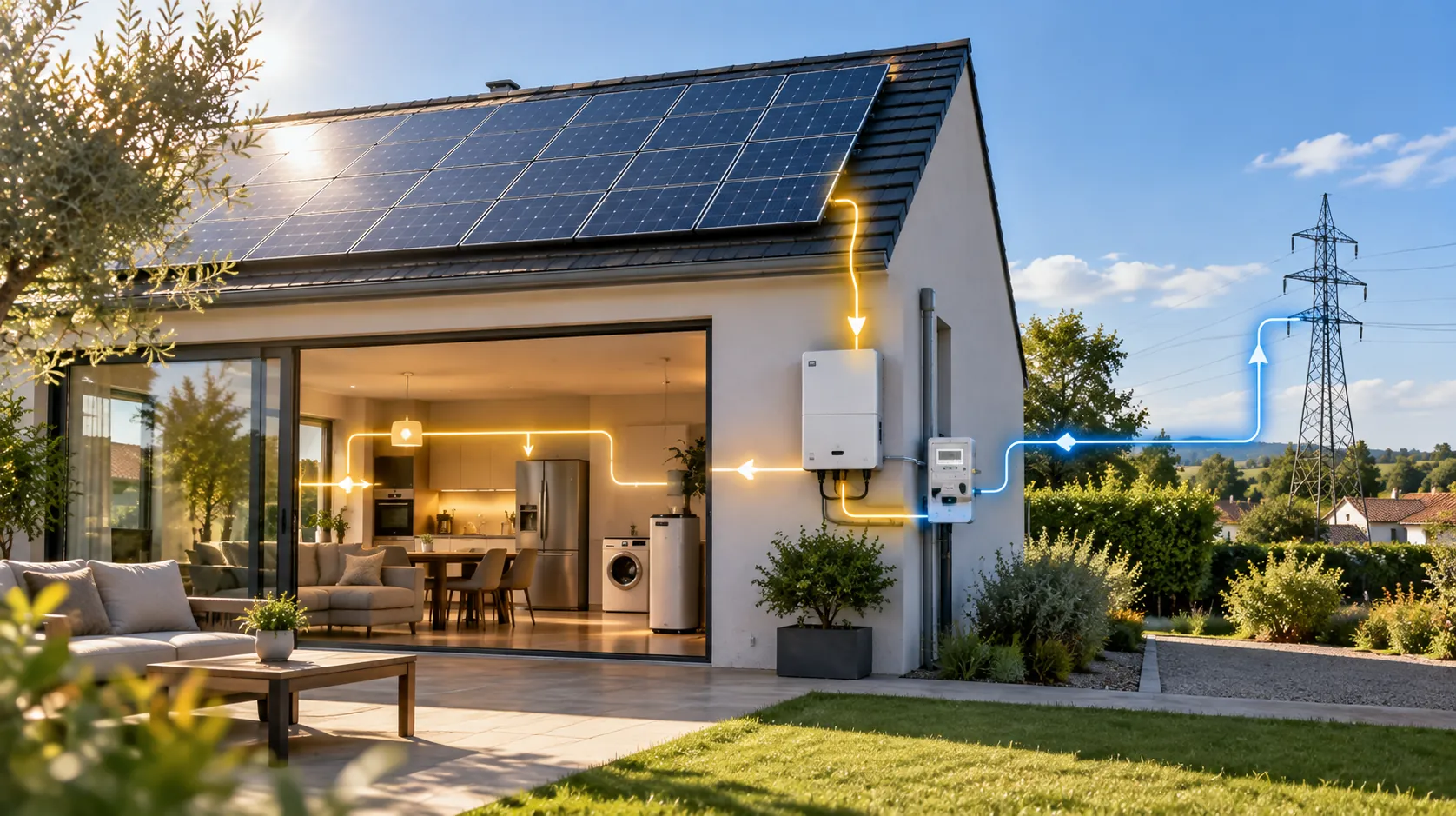
In other words, the grid now pays almost nothing for your surplus production. Each kilowatt-hour sent to the grid earns you barely more than one cent.
The new equation: €0.1940 versus €0.011
In the first half of 2026, one kilowatt-hour at EDF's Tarif Bleu (Base option, 6 kVA) costs €0.1940 incl. VAT. The same kilowatt-hour, injected into the grid, is purchased from you for €0.011.
One self-consumed kWh is therefore worth approximately 17 to 18 times more than a kWh sold to the grid. ×18
The conclusion is clear: the profitability of a solar installation in 2026 no longer depends on the grid or on incentives. It depends on a single variable that you control: your self-consumption rate — the share of your production that you consume yourself.
Example with figures: 6 kWp installation in southern France
Let us consider a 6 kWp installation in Occitanie, producing approximately 8 400 kWh per year (PVGIS basis, south-facing). Let us compare two scenarios according to the self-consumption rate:
| Without battery (45% self-consumed) | With battery (75% self-consumed) | |
|---|---|---|
| Self-consumed kWh | 3 780 kWh | 6 300 kWh |
| Bill savings (× €0.1940) | €733/year | €1 222/year |
| Surplus sold (× €0.011) | €51/year | €23/year |
| Total annual gain | ≈ €784/year | ≈ €1 245/year |
Two key lessons emerge. First, selling surplus has become marginal: €51 per year in the best-case scenario — less than one month's electricity subscription. Second, increasing self-consumption from 45% to 75% adds more than €460 in annual gains, or approximately €9 200 over 20 years. It is this difference that finances a battery, not surplus sales.
The three ways to maximise your self-consumption rate
1. Energy storage. A battery shifts your solar production from midday to the evening, when household consumption is concentrated. This is the most powerful lever: it typically increases the self-consumption rate from 40–50% to 70–80%. Sizing matters — an incorrectly sized capacity reduces the return on investment in both directions.
2. Managing energy use. Scheduling the water heater, electric vehicle charging or household appliances during production hours is free and increases self-consumption by 10 to 15 percentage points. Recent energy management systems do this automatically.
3. Correct sizing. Under the previous system, oversizing made sense: surplus was paid for. In 2026, each excess kWp produces electricity sold for one cent. A profitable installation is one sized to your actual consumption profile — not to the available roof area.
So, is solar profitable in 2026?
Yes — provided you think like a self-consumer, not a producer. A correctly sized installation with energy storage in southern France saves €1 100 to €1 300 per year on an electricity bill that will continue to change with the market (the Tarif Bleu is revised twice a year). For an investment of €12 000 to €15 000 including installation, the payback period is between 10 and 12 years, for equipment covered by a 20- to 30-year warranty.
What the reform has actually eliminated is not solar profitability. It is the profitability of poorly designed installations.
What would your actual savings be based on your consumption profile?
Request my free assessment Discover the turnkey offerFrequently asked questions
Does the self-consumption bonus still exist in 2026?
Not for new applications: the decree applicable since 5 June 2026 discontinued it. Applications submitted before this date retain the conditions in force at the time their complete grid connection application was submitted.
What is the solar surplus feed-in tariff in 2026?
1.1 c€/kWh excl. VAT for installations up to 100 kWp (applications submitted since 5 June 2026), under a 20-year EDF OA purchase obligation contract indexed at 2% per year.
Has a battery become essential?
It is not essential, but its economic equation has improved significantly: each kWh stored and then consumed is worth €0.1940 instead of €0.011 if it had been injected into the grid. Energy storage has gone from being a comfort option to becoming the primary profitability lever.
Can I still sell all my production?
Not for installations of 9 kWp or less: since March 2025, only self-consumption with surplus sales remains available under the purchase obligation scheme.
Is solar still profitable without any incentives?
Yes, because its profitability now relies on the electricity you no longer have to pay for (€0.1940/kWh in the first half of 2026), rather than on subsidies. The continued reduction in equipment costs has offset the disappearance of incentives.
Data: amending tariff decree of 1 June 2026 (applicable from 5 June 2026); EDF Tarif Bleu Base option 6 kVA, first half of 2026; estimated yield via PVGIS. Figures provided for information purposes only — the Tarif Bleu is revised every 1 February and 1 August, while feed-in tariffs are revised quarterly. Article updated in July 2026.