Français
Your panels are installed: the first-year guide
The installation is complete, the app is displaying your first kilowatt-hours, and a new series of questions is coming up: do you need to change your EDF tariff? What do these figures mean? Is winter production normal? Do the panels need cleaning? Here is everything that awaits you during the first year — and the very short list of what you actually need to do.
Week 1: get familiar with the app
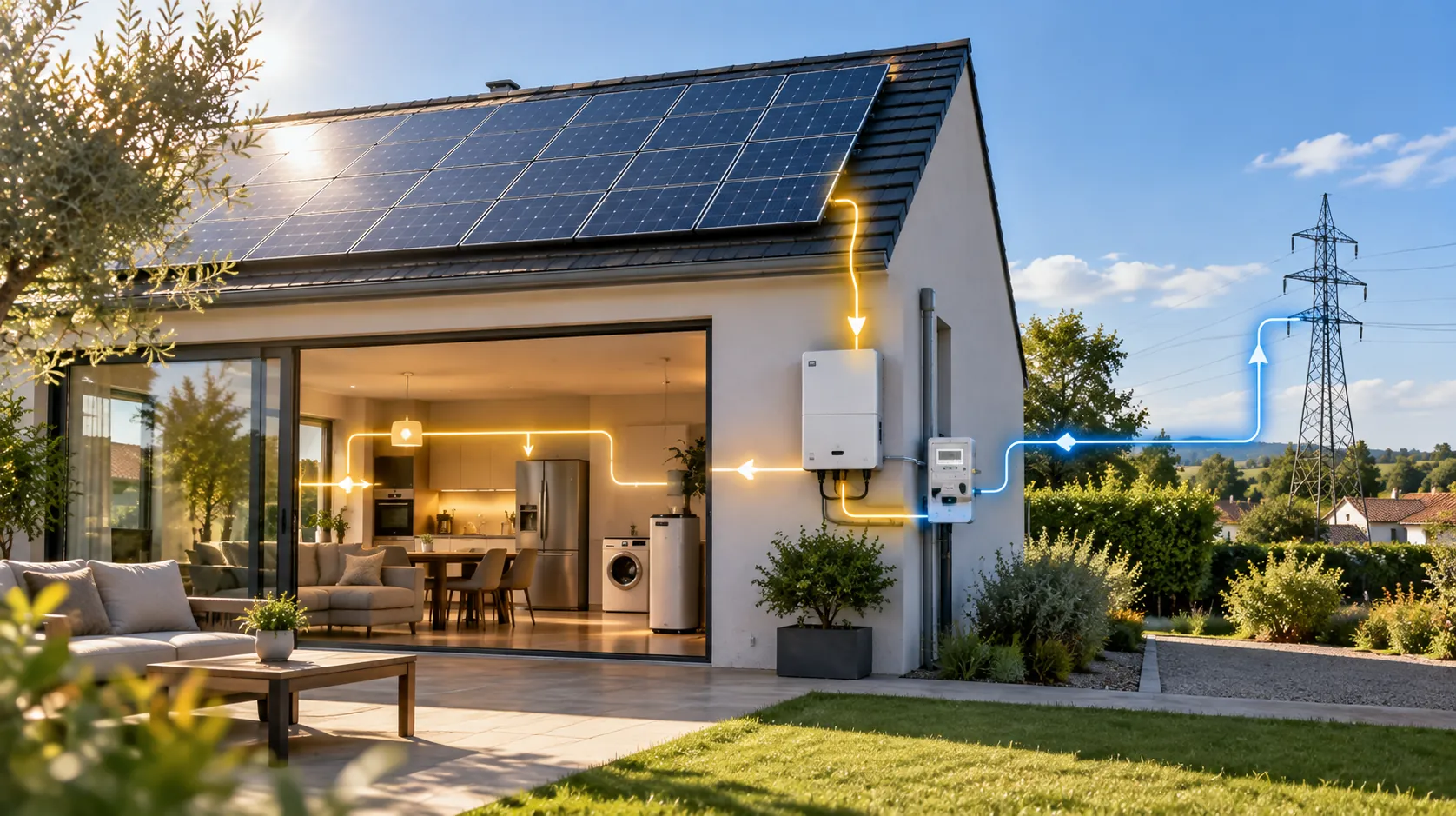
Your monitoring app displays a lot of figures, but only three deserve your attention. Production: what your panels generate. Consumption: what your home uses. And above all, the self-consumption rate: the share of your production that you consume yourself — this is what generates your savings, since each kWh consumed in your home is worth nearly 18 times as much as a kWh injected into the grid.
The right habit during the first week: check what time your production exceeds your consumption, and shift whatever activities can be moved to that time — washing machine, dishwasher, water heater. This simple change in habits increases self-consumption by 10 to 15 points, free of charge. And then? Let it run: the system operates automatically.
Month 1: the EDF tariff question
Your panels do not change anything about your existing contract — but they may change what is optimal for you. There are two points to examine calmly during the first month. The subscribed power: if you were on 9 kVA “as a precaution”, your reduced grid consumption thanks to solar may sometimes allow you to step down a level and save on the tariff itself. The tariff option: off-peak hours lose some of their appeal when your midday electricity is already free — a Base tariff may once again be simpler and cheaper. There is no universal answer: we are preparing a dedicated guide to help you choose according to your profile.
Summer and winter: what a normal year looks like
The first year comes as a surprise to almost everyone: the scale of seasonal variations. This is normal, and here are the typical ranges to avoid unnecessary concern:
| Period | Typical production | What is normal |
|---|---|---|
| April – September | 65 to 70% of the year | Record days, a full battery by 2 p.m. |
| October – March | 30 to 35% of the year | Production divided by 2 to 3 compared with June |
| December – January | The low point | Sometimes 4 to 5 times lower than in summer: this is not a fault |
The right approach: compare your production with the same month, not the previous month. December at 25% of June is perfectly healthy. June at 50% of another June deserves a closer look.
“My production has dropped”: a 3-step self-diagnosis
Does a figure seem abnormal? Before calling anyone, carry out three two-minute checks. One: the weather over the last few days — a cloudy week will reduce the output of any installation. Two: shading — a tree that has grown, a neighbouring scaffold, or even a partially shaded panel can have an impact depending on the configuration. Three: the app — a panel or inverter reporting a fault will be clearly indicated. If none of the three checks reveals anything and the gap persists over several sunny weeks, call us: this is exactly why your contact remains available after installation.
Actual maintenance: less than your car
The good news in this chapter: it is short. The panels are self-cleaning by design — rain and the tilt remove most dust. Cleaning is only necessary once or twice a year if your surroundings require it: heavy pollen, proximity to fields, sand or bird droppings. In that case, use clear water and a soft brush with a telescopic handle, early in the morning when the panels are cool — or a professional if the roof is high: your safety is worth more than a few kWh. Never use a pressure washer, very hard water or abrasive products.
The rest of the “maintenance” simply consists of checking the app from time to time. That is all. No oil change, no mandatory annual service, no wear parts for many years.
Hail, storms and lightning: are you covered?
Your panels are designed to withstand far more than you might imagine — the modules we install resist standardised hail impacts as well as snow and wind loads. For exceptional events, the administrative process is simple: once installed, your panels form part of the building and come under your home insurance. Notify your insurer as soon as they are commissioned (most include them without an additional premium), keep your invoice, and in the event of severe weather, take photographs and file a claim within the usual time limits. Hardware warranties — often 15 to 30 years for panels — cover defects independently of weather conditions.
What awaits you in the years ahead
After the first year, you know the pattern and the installation fades into the background. Two possibilities are worth keeping in mind. The battery, if you do not already have one: your first year of data shows precisely what you inject into the grid for 1 cent — the best possible basis for a decision, and it can be added without touching the panels (our battery guide explains the calculation). The electric vehicle, if you have been considering the idea: an existing installation works very well with a charging point — we have devoted an entire section to it.
Do you have a question about your installation? A real person will answer you.
04 49 42 00 99 Contact usFrequently asked questions
Do solar panels need cleaning?
Rarely: rain does most of the work. Cleaning with clear water once or twice a year is sufficient in dusty environments (pollen, fields or sand). Never use a pressure washer, and never risk your balance on a roof — a professional can take care of it for a few dozen euros.
My winter production is very low. Is this normal?
Yes. December and January typically produce 4 to 5 times less than June: shorter days, low sun and cloudy skies. The relevant comparison is always with the same month of the previous year, never with summer.
Do I need to notify my home insurer?
Yes, simply notify them when the system is commissioned. The panels form part of the building and are covered by comprehensive home insurance under most policies, generally without an additional premium. Keep your installation invoice.
What happens to the panels at the end of their service life?
They are more than 90% recyclable (glass, aluminium and silicon) through the dedicated French recycling scheme, funded by an environmental contribution already included in the purchase price. But this is a long way off: your panels will still produce 80% or more of their power after 25 years.
Can I add a battery or more panels later?
Yes, in the vast majority of cases, and this is actually the most common approach: the first year of data reveals exactly what you are missing. Adding a battery does not affect the existing panels; adding panels depends on the available space and the equipment already in place — a quick assessment will confirm this.
Seasonal production distribution provided for guidance for mainland France (varies according to region and orientation). Insurance conditions depend on the policy — check with your insurer. Article updated in July 2026.