Français
“How much does a solar kit cost?” It is almost always the first question — and the answer is usually the vaguest one you find online. You come across all sorts of figures: a €300 kit, another at €15,000. Enough to make you wonder whether people are really talking about the same product.
They are talking about the same product. But a small 500 W plug-and-play kit costs around €300 to €600, whereas a 9 kW installation with a battery can exceed €15,000. In between, there are different power levels, equipment choices and installation options that can make the figure vary considerably.
This guide sets out the real price ranges for a solar kit in 2026, power level by power level, with and without a battery. The aim is not to sell you a price. It is to tell you what budget to plan for before you even open a product datasheet, and why two kits listed at the same power output can cost twice as much as each other.
Key takeaway: the price ranges given in this guide are general benchmarks observed on the French self-consumption solar kit market. They are intended to help you assess a budget, not set a price. Actual prices depend on the equipment brand, battery capacity and installation work: only a dated quote is authoritative.
Informational content updated at the end of May 2026.
What determines the price of a solar kit
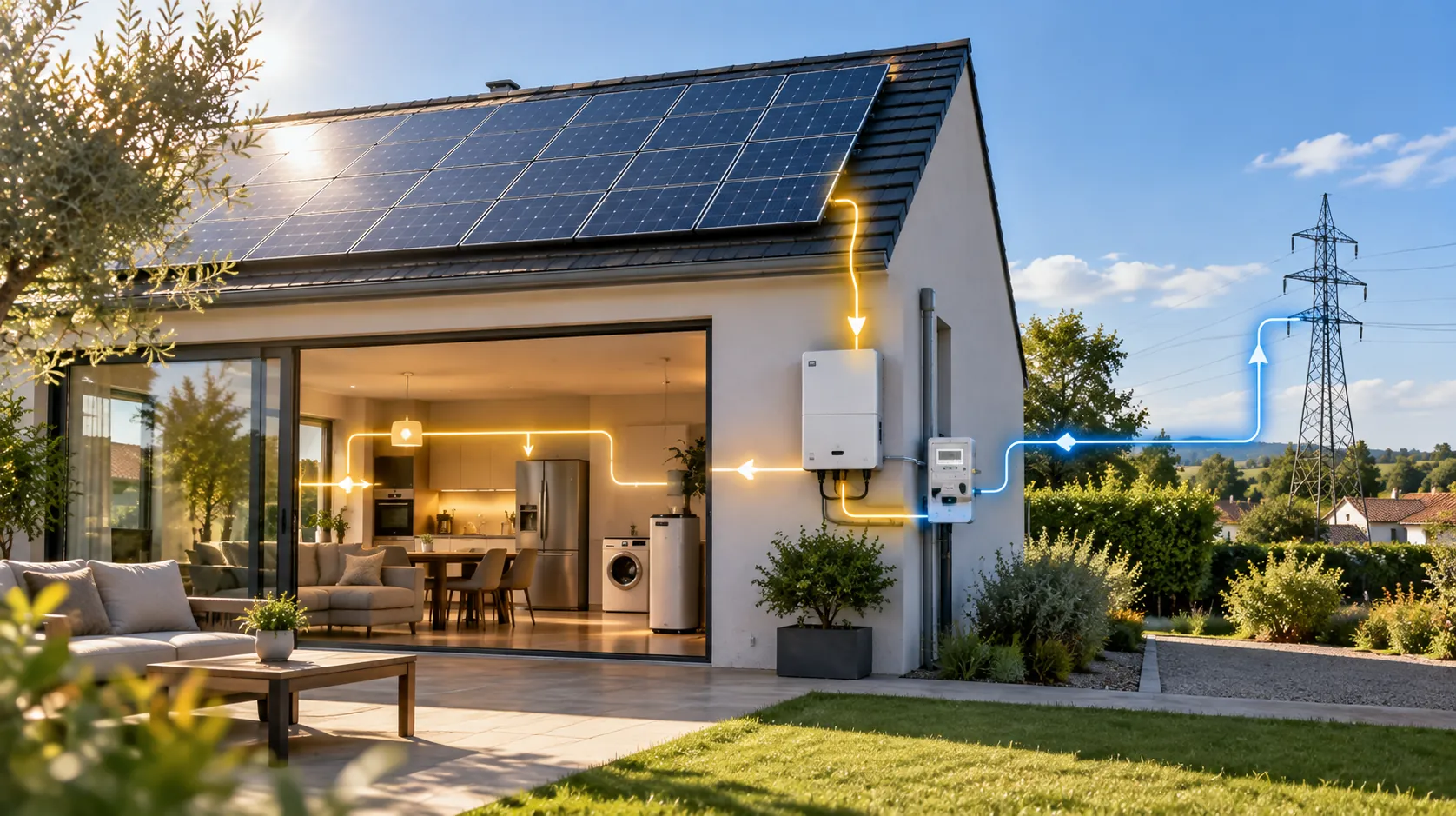
Before looking at the figures, let us look at what you are buying. The price of a self-consumption solar kit is broken down into clearly identified components, and it is the balance between them that explains the difference between two kits with the same power output.
- Photovoltaic panels: the core of the installation. Efficiency, brand and cell type (monocrystalline, half-cell technology, bifacial) push the price per watt-peak up or down.
- The inverter or microinverter: it converts the panels' direct current into usable alternating current. A hybrid inverter capable of controlling a battery costs more than a simple string inverter.
- The energy storage battery: the component with the greatest impact on the price. Storing energy for use in the evening can represent a very significant share of the total cost, often similar in scale to the cost of the rest of the installation combined.
- The racking system: whether installed on the ground, a pitched roof or a flat roof, the mounting system does not cost the same.
- Installation: a plug & play kit can be connected to a socket yourself. A kit with several kilowatts connected to the electrical panel, however, requires an installer, generally RGE-certified.
Keep these components in mind and you will immediately understand why a “bare” 3000W solar kit price and a complete kit with battery and installation have nothing in common. It is not the same product with a discount. They are two different projects.
Solar kit price table for 2026 (by power output)
Here are indicative ranges observed on the French market at the beginning of 2026, for new, quality equipment. Prices are stated excluding subsidies and before installation for power outputs requiring an installer. These are benchmarks to help you assess your budget, not a price commitment.
| Power output | Typical use | Price without battery | Price with battery | Suitable for |
|---|---|---|---|---|
| 500 W | Supplementary power, plug & play socket | €300 – €600 | €700 – €1,200 | Apartment, first steps |
| 3,000 W (3 kW) | 2–3-person household | €2,000 – €4,000 | €4,500 – €8,000 | House, genuine self-consumption |
| 6,000 W (6 kW) | Family home | €4,000 – €7,000 | €8,000 – €13,000 | High consumption, large appliances |
| 9,000 W (9 kW) | Large house, three-phase power | €6,000 – €10,000 | €11,000 – €18,000 | Heat pump, EV charging |
These ranges cover the main equipment. Professional RGE installation, when required, is added separately and also determines eligibility for certain subsidies (see below).
To compare models at each power level, browse the complete selection of self-consumption solar kits: each product displays its power output, equipment and up-to-date price.
500W solar kit: the entry point
The 500W plug & play solar kit is the entry point. One or two panels that you place on a balcony, terrace or small roof, then connect to a standard socket. No construction work. No string inverter to wire. You want to reduce your electricity bill without committing to a large installation: this is exactly what you need.
Allow €300 to €600 for a ready-to-connect kit, and more if you add a micro-battery to shift consumption to the evening. It is also the best way to test self-consumption in real-life conditions before increasing your power output. For example, see the HYXiPOWER 500W plug & play solar kit, designed for autonomous installation in just a few minutes.
3000W solar kit: the self-consumption standard
The 3000W solar kit is a firm favourite among French households. With 3 kW, it covers a significant share of the needs of a 2- to 4-person home: appliances, lighting, standby devices and part of the supplementary electric heating during the day.
In terms of budget, the 3000W solar kit price is around €2,000 to €4,000 without energy storage. Add a battery and the price rises to €4,500 to €8,000. In return, you gain the ability to use the energy produced in the afternoon during the evening — and this is precisely where profitability is determined: by the self-consumption rate.
For an installation designed to last, the HYXiPOWER 3000W professional self-consumption solar kit is a good example of this segment: professional-grade equipment, ready for connection to the electrical panel and compatible with a battery extension.
6000W and 9 kW solar kits: for high-consumption households
Above 6 kW, the target audience changes. These systems are aimed at households with high consumption: heat pumps, thermodynamic water heaters, electric vehicle charging and even three-phase power for 9 kW systems.
A 6000W kit costs between €4,000 and €7,000 without a battery, while a 9 kW system costs between €6,000 and €10,000. With energy storage, these installations frequently exceed €10,000. At this level, professional RGE installation is almost always required. This is also when grid connection procedures (Consuel and Enedis, the grid operator) come into play.
The cost of a solar kit with a battery: should you take the plunge?
The cost of a solar kit with a battery is the major question in 2026. The battery is the most expensive component of the installation. And it is not cost-effective in every situation — that is the key issue.
You may think that a kit with a battery is necessarily better. Not so fast. It all depends on when you consume electricity. Without a battery, you use electricity when it is produced, during the day, and sell or inject the surplus into the grid. For a household that is unoccupied during the day, the self-consumption rate often remains modest: much of the midday production is sent to the grid because it is not used on site. With a correctly sized battery, this rate can increase significantly because you store the midday surplus for use in the evening, when consumption peaks.
The calculation is therefore straightforward. A battery makes sense if your consumption is high in the evening and if the difference between the electricity you avoid buying and the electricity you sell justifies the investment. For a small household that mainly consumes during the day, the opposite is true: a kit without energy storage often offers the best balance between price and savings.
One point that is too often overlooked is service life. A quality lithium battery generally comes with a 10-year manufacturer warranty, whereas panels last 25 years or more. In other words, the battery will probably need to be replaced once during the installation's lifetime. Factor this future cost into your profitability calculation now.
Subsidies in 2026: their impact on the actual price
Several public schemes reduce the price of a solar kit, but their amounts and conditions often change. We are deliberately cautious with the figures: photovoltaic subsidy rates are revised regularly.
- The self-consumption bonus: paid for self-consumption installations with surplus injection, connected by an RGE installer. Its amount, in €/kWp, is revised every quarter by the public authorities and has been reduced several times in recent years. Check the current quarterly rate for the exact amount applicable to your power output.
- The reduced VAT rate: a reduced rate applies to low-power residential photovoltaic installations, compared with the standard rate of 20%. Thresholds and the exact rate may change from one Finance Act to the next; have this confirmed on a dated quote.
- The surplus feed-in tariff (purchase obligation): EDF Obligation d'Achat (or another approved buyer) purchases your surplus at a tariff set by decree and guaranteed by contract for 20 years. This additional income improves profitability.
- Local subsidies: some regions, departments and municipalities offer specific subsidies. Contact your local authority and the France Rénov' advice centre.
Important: plug & play kits installed by the customer generally do not qualify for the self-consumption bonus, which requires installation by an RGE installer and a grid connection declaration. If access to subsidies is important to you, choose an installation connected to the grid and installed by a professional.
As these amounts change with successive decrees, check the 2026 figures on service-public.fr or with your installer rather than relying on a fixed amount. For details of each scheme, see our complete guide to government subsidies for solar energy in 2026. It is also a test of a seller's reliability: be wary of anyone promising a “guaranteed” subsidy without an RGE quote.
Solar kit prices: how to avoid unpleasant surprises
When comparing a solar kit price displayed by several retailers, the price alone tells you nothing. Check what it includes:
- Is the equipment complete? Panels, inverter, cabling, mounting hardware and, where applicable, battery. A very low price often conceals a partial kit.
- Is installation included? For power outputs of 3 kW and above, labour represents a significant share of the budget.
- What warranties are included? Quality panels with a 20- to 25-year performance warranty, inverters often with 10 to 12 years, and batteries with around 10 years. A short warranty is a warning sign.
- Is after-sales service based in France? If an inverter or battery fails, having a reachable contact makes all the difference.
What budget should you plan for based on your profile?
To move from a price range to a decision, start with your situation, not the power output:
- Tenant or apartment resident: a 500W plug & play kit starting at €300 is the only realistic option. Minimal investment, immediate start-up and no construction work.
- House, 2- to 4-person household: the 3000W solar kit costing €2,000 to €4,000 without a battery offers the best balance between coverage and budget. With a battery, allow €4,500 to €8,000.
- Large house, heat pump or electric vehicle: aim for 6 to 9 kW, costing €4,000 to €10,000 without a battery and more than €10,000 with energy storage. RGE installation and Enedis grid connection form part of the budget.
In every case, correct sizing starts with your actual annual consumption — in kWh, as shown on your bills — rather than a rough guess.
Frequently asked questions
How much does a solar kit cost in 2026?
The price of a solar kit in 2026 ranges from around €300 for a 500 W plug & play kit to more than €15,000 for a 9 kW installation with a battery. A 3000W kit, the most common format, costs around €2,000 to €4,000 without energy storage. These ranges exclude subsidies and installation for power outputs requiring an installer.
How much does a 3000W solar kit cost?
The 3000W solar kit price is approximately €2,000 to €4,000 for the equipment alone, and €4,500 to €8,000 with an energy storage battery. This is the power output best suited to a 2- to 4-person household seeking genuine self-consumption.
How much does a solar kit with a battery cost?
The cost of a solar kit with a battery depends primarily on the storage capacity selected. The battery is the most expensive component: depending on the power output, it can represent a very significant share of the total budget. For example, allow €4,500 to €8,000 for a 3000W kit with a battery, compared with €2,000 to €4,000 without one.
Is a solar kit profitable in 2026?
Yes, in most cases, provided that the installation is correctly sized in relation to your consumption. Profitability is based on the savings made by consuming your own electricity, supplemented by surplus injection and, where applicable, subsidies. A battery improves the self-consumption rate but extends the payback period.
Conclusion: what budget for which solar kit in 2026?
The price of a solar kit in 2026, in brief:
- 500 W plug & play: from €300, to get started without commitment.
- 3,000 W: the self-consumption standard, between €2,000 and €4,000 without a battery.
- 6,000 W to 9 kW: for high-consumption households, from €4,000 to €10,000 depending on the power output, excluding the battery.
- With a battery: a significant additional cost, mainly justified if you consume electricity in the evening, and provided that you plan for battery replacement after around ten years.
The right kit is not the largest or the cheapest. It is the one that matches your actual consumption and lifestyle. To move from a price range to a concrete choice, browse our range of self-consumption solar kits: each model displays its power output, equipment and up-to-date price, from the small 500W plug & play kit to the 3000W professional kit designed for long-term self-consumption.
This article is provided for general informational purposes. The prices shown are general benchmarks observed on the market and do not constitute a commercial offer; subsidies, their amounts and their conditions change regularly. Before making any decision, request a dated quote and check the current rates with official sources (service-public.fr) or a France Rénov' adviser.