Français
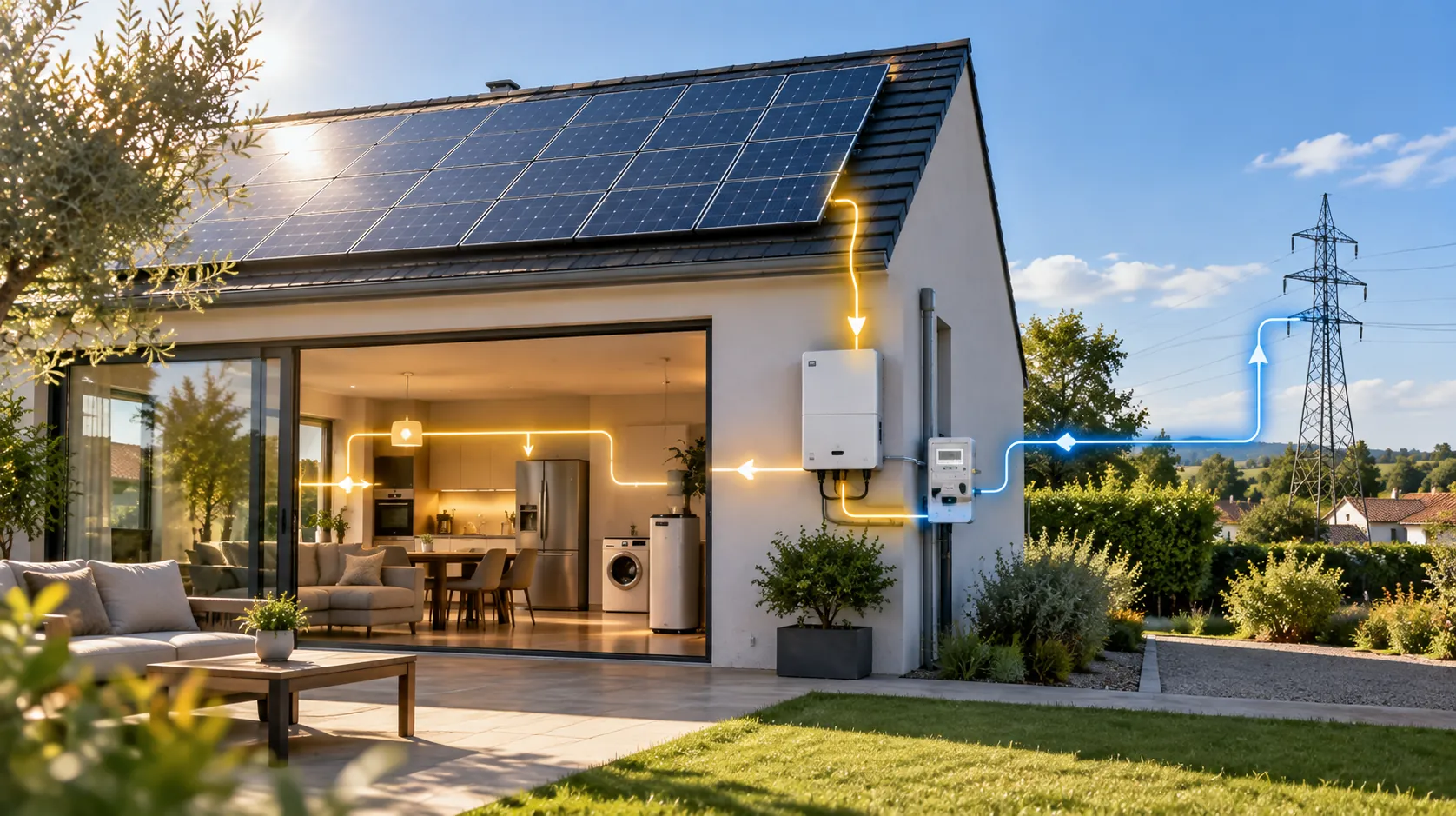
Your panels produce power in the middle of the day — precisely when nobody is home. In the evening, when everything switches on, you buy that same electricity back from the grid at a premium price. This is exactly the mismatch that a 3000W self-consumption solar kit with battery is designed to correct — and this is where it is easy to get lost in watts, kWp and profitability promises.
The 3 kWp system is now one of the most popular formats among French households. Powerful enough to cover a significant share of a home's consumption. Compact enough to remain affordable and, very often, suitable for DIY installation.
This guide gets straight to the point. How much does a 3000W kit really produce, what is the battery for, how should the system be sized, how much does it cost in 2026 and which models are reliable. The goal: buy the right kit the first time, without having to pay again in two years.
Why choose a 3000W solar kit?
A 3000W self-consumption solar panel (that is, 3 kWp, kilowatt-peak), is the balance point between what the roof produces and what you spend. Neither a token-sized kit nor an oversized installation that would take fifteen years to pay for itself.
What does a 3 kWp kit produce?
In mainland France, 1 kWp of installed capacity produces an average of between 900 and 1 400 kWh per year depending on the region, orientation and tilt (typical figures observed in residential operation). Let us calculate this for 3 kWp: you obtain between 2 700 and 4 200 kWh per year. Higher yield in the south-east, more moderate in the northern half.
Compare this with your consumption. A French household without electric heating commonly uses between 3 000 and 4 000 kWh per year. In other words, a well-oriented 3000W kit covers a significant share of your basic needs: household appliances, lighting, hot water and device charging.
Which type of home is it suitable for?
The 3 kWp system is a good fit in three situations:
- a detached house with a well-exposed roof or plot (south, south-east or south-west);
- a household of 2 to 4 people that genuinely consumes electricity during the day (working from home, appliances running while the sun is shining);
- the desire to start self-consumption without committing the budget required for a 6 kWp or 9 kWp system.
What is an energy storage battery used for?
Without a battery, you only consume your solar energy while the sun is producing it. The surplus is sent to the grid and sold for next to nothing. In the evening, when your consumption increases sharply, you buy that same electricity back at a premium price.
The problem is therefore not how much you produce. It is when you produce it. A solar energy storage battery specifically corrects this mismatch.
The production/consumption mismatch
Solar production peaks in the middle of the day. Your consumption, on the other hand, is concentrated in the morning and especially in the evening — when you come home, the kitchen is running and everyone is at home. The battery stores the afternoon surplus and supplies it after sunset. Electricity that you would have sold off cheaply becomes electricity that you would otherwise have bought back.
The effect on the self-consumption rate
Without energy storage, a household self-consumes around 30 to 40% of its production. The rest goes to the grid. With a correctly sized battery, this rate often rises above 70%. In practical terms: less electricity purchased, with each kWh produced used more effectively.
You may be thinking that a battery is necessarily profitable. Not so fast — it all depends on when you consume electricity. The more you use in the evening, the more it pays off. If the house is empty during the day and you mainly live there after 19 h, the figures clearly work in its favour.
What battery capacity is suitable for a 3000W kit?
The practical rule: a capacity of between 2,5 and 5 kWh is well suited to 3 kWp of production for typical residential use. Below this, the battery fills too quickly in summer and the surplus still goes to the grid. Above this, the additional cost takes longer to pay back if your evening consumption remains moderate.
In terms of technology, choose lithium iron phosphate (LFP / LiFePO4). More thermally stable, it generally offers several thousand charging cycles, equivalent to 10 to 15 years of daily use. You will find a selection of compatible models in our plug-and-play batteries category.
Plug-and-play kit or conventional installation?
A 3000W plug-and-play solar kit is a pre-assembled system designed to be installed without making major changes to the electrical panel — sometimes simply by connecting it to a dedicated socket. It is the choice for people who want to stay in control of their budget and schedule.
The advantages of plug-and-play
- Quick installation: no construction work dragging on, often half a day to a full day depending on the installation.
- Controlled cost: you save a substantial share of the labour cost.
- Scalability: many product ranges allow you to add panels or a battery later.
Points to watch
Be precise about the regulations. Any installation connected to the grid must be declared to the grid operator (Enedis in most cases). To receive public subsidies, depending on the configuration, you will generally be asked to use an RGE certified installer (Reconnu Garant de l'Environnement). A kit installed independently can remain fully compliant if it follows the rules. However, it does not necessarily give you access to the same financial support as a professional installation. You must decide according to your priority: save on installation costs or maximise financial support.
How much does a 3000W solar kit with battery cost in 2026?
The price depends on the quality of the panels, the type of inverter (centralised or microinverters), the battery capacity and the level of pre-assembly. But let us be specific: for an identical configuration, the biggest cost is not the panels, but the energy storage battery. This is what creates the price difference between two kits. For up-to-date prices and a comparison by model, refer to the linked product pages below — a generic price range would be outdated before you had even read it.
Government support in 2026: what you need to know
Several schemes can reduce the cost, but their amounts and conditions often change. Here are the stable principles — always check the current scale when planning your project:
- Self-consumption bonus: paid for self-consumption installations with surplus injection, connected under a purchase obligation contract. The amount is expressed in euros per kWp, is degressive according to power and reviewed every quarter. As the scale has changed significantly in recent years, check the current amount on service-public.fr or with your installer before making a decision.
- Reduced VAT rate: low-power residential photovoltaic installations may qualify for a reduced VAT rate compared with the standard rate of 20%, subject to conditions (power, professional installation and grid connection). As thresholds and rates are adjusted through successive Finance Acts, ask your installer for the exact rate, have it confirmed in writing on the quote and check the up-to-date information on service-public.fr.
An honest point. Most of these subsidies require an installation to be installed and connected by an RGE professional. A kit purchased for independent installation is generally not eligible. If maximising financial support is your priority, find out the exact conditions before purchasing, not afterwards.
Which 3000W solar kit should you choose?
Everything depends on your priority: performance and durability on one hand, ease of installation and scalability on the other. Two profiles, two kits.
For performance: the HyxiPower professional kit
Our HyxiPower 3000W professional self-consumption solar kit is intended for those who want a 3 kWp installation built to last. It is the right choice if you are looking for high efficiency and a configuration that you will not need to upgrade in five years.
For simplicity: the Sigenergy plug-and-play kit
Would you prefer hassle-free commissioning and an all-in-one battery that can expand with your needs? Take a look at the Sigenergy 3000W plug-and-play solar kit. The range combines energy storage and control electronics in one coherent system, designed to grow over time.
Choosing and sizing your battery
Whatever kit you choose, the battery is the component that will determine your actual self-consumption rate. Compare capacities, technology (LFP recommended) and the number of stated cycles in our plug-and-play energy storage batteries category.
How to correctly size your 3000W kit with battery
Correct sizing does not start with the datasheet. It starts with your bills. Four steps:
- Estimate your annual consumption (in kWh) based on your bills. This is the foundation for everything else.
- Measure your evening consumption: the higher it is, the more a battery close to 5 kWh is justified.
- Check your exposure: a south-facing orientation and minimal shade make the most of your 3 kWp.
- Plan for the future: electric vehicle, heat pump or extension? Choose a scalable range rather than oversizing from the outset.
Frequently asked questions
Is a 3000W solar kit with battery profitable?
It mainly depends on three figures: your electricity purchase price, your self-consumption rate and the initial cost of the kit. With a battery that raises self-consumption above 70%, each kWh produced replaces one kWh purchased from the grid. The higher the electricity tariff rises, the faster the payback. The real key to a good return is not the biggest kit — it is an honest sizing based on your actual consumption.
Do you need authorisation to install a 3000W kit?
For any installation connected to the grid, a declaration to the grid operator (Enedis) is required, and a prior works declaration to the local council may be necessary depending on the installation (roof, façade or ground). A plug-and-play kit simplifies the technical installation but does not exempt you from these procedures when there is grid injection. Check local rules before ordering.
How many panels are needed for a 3 kWp kit?
It all depends on the power of each module. With 400 to 500 Wp panels, a 3 kWp kit generally contains 6 to 8 panels. The product pages for our 3000W kits provide details of the exact configuration, number of modules and required surface area.
Can a 3000W kit be expanded later?
Yes, provided you choose a scalable range from the outset. Modular systems, such as the Sigenergy range, allow you to add panels or battery modules when your consumption changes (the arrival of an electric vehicle or heat pump). Always check inverter compatibility before adding anything.
What happens to the surplus electricity produced?
Once the battery is full and your needs are covered, the surplus is sent to the grid. You can sell it under a purchase obligation contract (surplus injection), which is also a requirement for the self-consumption bonus. Correctly sizing your battery is precisely about reducing this cheaply sold surplus and consuming as much of your own production as possible.
In summary
A 3000W self-consumption solar kit with battery is now one of the best compromises for a French household: 2 700 to 4 200 kWh produced per year, a self-consumption rate pushed above 70% through energy storage, and an accessible installation in plug-and-play format.
The right kit is not the most powerful or the cheapest. It is the one that matches your actual consumption. Start with your bills, choose an LFP battery, check your financial support before buying — and compare the two configurations that cover most user profiles:
- performance with the HyxiPower 3000W professional kit;
- simplicity with the Sigenergy 3000W plug-and-play kit;
- tailored energy storage in our plug-and-play batteries category.