Français
Your electricity bill has gone up again, and you are starting to take a closer look at solar power. Then you open the first comparison guides: kWp, inverter, single-phase, self-consumption rate, incentives that change every quarter. Enough to make you close the tab.
We are going to do the opposite here. No pile-up of jargon, but a decision-making method. By the end, you will know exactly what to look at before buying a solar kit: the power, whether or not to include a battery, the connection, and the incentives applicable in 2026. This is the same approach we use at Kitsolaire to advise our customers.
A self-consumption solar kit, in practical terms
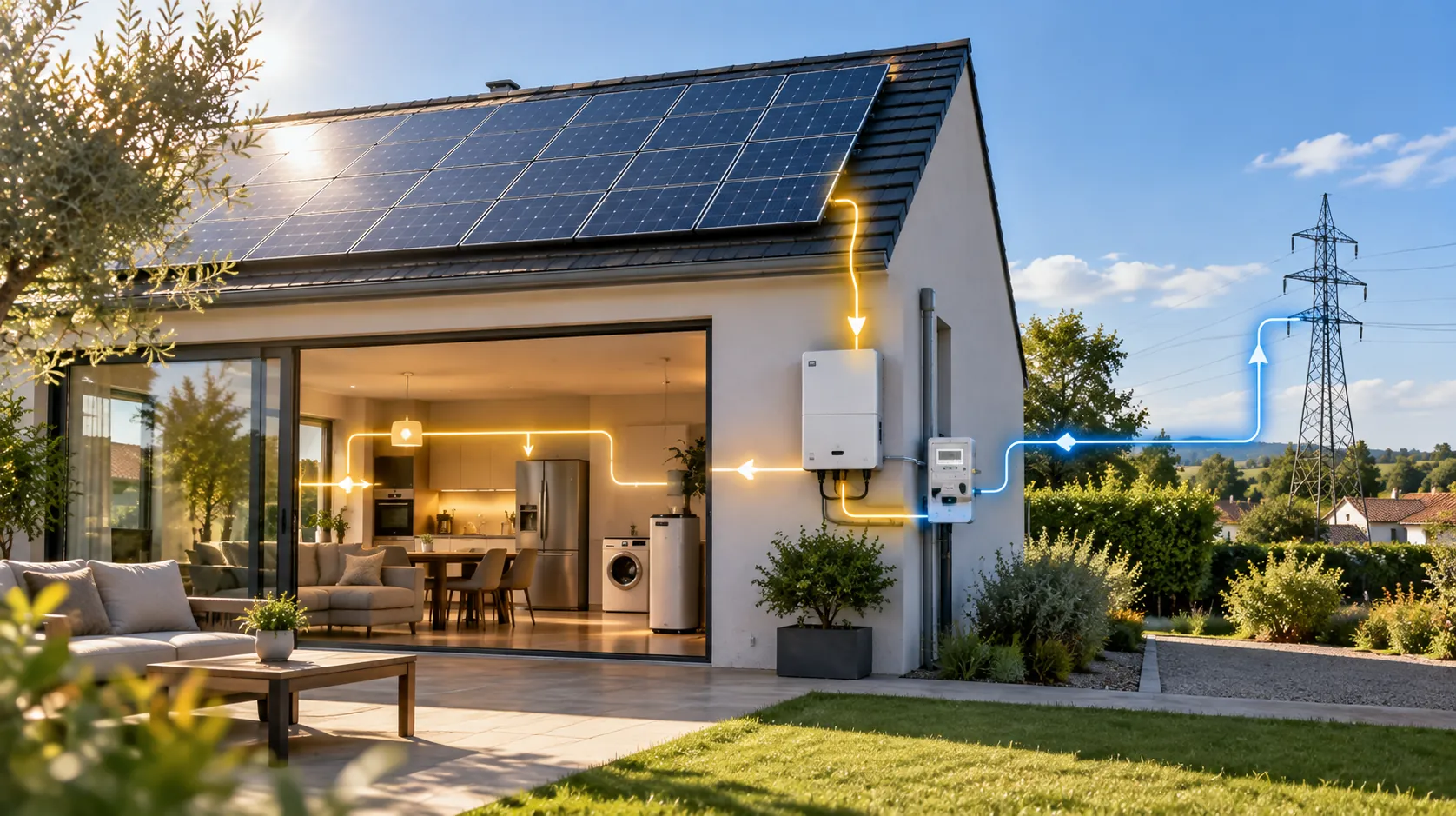
A solar kit includes all the equipment needed to produce your own electricity: the panels, the inverter (or microinverters), the racking system, the cabling, and increasingly often a battery.
We talk about a self-consumption solar kit when this electricity is first consumed in your home, instead of being sold in full. In clear terms: your panels primarily power whatever is running in the house — refrigerator, internet box, water heater. The surplus either goes into a battery or back to the grid, where it is purchased by EDF Obligation d'Achat.
The benefits are twofold. You reduce your bill immediately, and you partly protect yourself against future increases. Our range of self-consumption solar kits covers all these configurations, from a small supplementary kit to a complete installation with energy storage.
Plug and play or fixed roof installation?
Two families, two approaches.
- The plug and play kit connects to a standard socket, with no major building work. Perfect for getting started, supplementing an existing installation or equipping a balcony. Power ratings range from 300 W to a few kW.
- The fixed roof kit is installed on the roof covering and connected to the electrical panel. This is the option to choose for genuine production — 3, 6, 9 kWp and more — and to qualify for government incentives.
The question is not “which one is best?”, but “what do I want?”. To gain a few percentage points of energy independence, or to cover a large share of your annual consumption.
Step 1: Find the right power rating (in kWp)
Power is expressed in kilowatt-peak (kWp): the maximum power under strong sunlight. This is the first criterion, and the one that determines everything else.
Start with your consumption, not the datasheet
The instinct to avoid: choosing the largest solar kit possible. The right approach: size it according to your annual consumption, in kWh. You can find this on your annual bill or in your Enedis customer account.
As a general indication, in mainland France, 1 kWp in a well-oriented position produces between 900 and 1 300 kWh per year, depending on the region and orientation — the south being significantly more generous than the north. This is an average: tilt, orientation and shading affect the result.
Some sizing guidelines
Here are some typical guidelines for a detached house:
| Household profile | Indicative annual consumption | Typical selected power |
|---|---|---|
| Small home, few appliances | 3 000 – 4 000 kWh | 3 kWp |
| Family, standard house | 5 000 – 7 000 kWh | 6 kWp |
| Large house, heat pump, electric vehicle | 8 000 kWh and more | 9 kWp and more |
These guidelines are deliberately cautious. Oversizing to inject a large amount of surplus is rarely profitable, because the purchase rate is low (we will come back to this below). The purpose of a self-consumption solar kit is not to produce electricity for resale, but to cover what you consume.
The 9 kWp threshold: the key level to know
The 9 kWp level is a major regulatory and tax threshold in 2026. At or below 9 kWp, you remain within the simplest scheme for a private individual: reduced VAT, a one-off incentive payment, and simplified procedures. Above this level, the conditions change. For the vast majority of households, choosing 3, 6 or 9 kWp therefore remains the most consistent option.
Step 2: With or without a battery?
This is the question that comes up most often. Do you need a solar kit with battery? You may think that having a battery is necessarily better. Not so fast: it all depends on when you consume electricity.
Without a battery: consume what you produce, directly
Without energy storage, you use electricity when it is produced — during the day. The surplus goes to the grid. This configuration costs less to purchase, and makes sense if you are at home during the day: working from home, a water heater controlled during solar hours, and so on.
Its self-consumption rate generally ranges from 30% to 50% without any specific control system.
With a battery: produce during the day, consume in the evening
The battery stores the surplus produced during the day so that you can use it in the evening and at night, when you consume the most. It significantly increases your self-consumption rate. This is the right choice in three cases:
- you are rarely at home during the day;
- you want to maximise your independence from the grid;
- you are planning for long-term tariff increases.
Solutions have matured. All-in-one systems such as the SigenStor, with integrated battery and inverter, combine the inverter, energy management and energy storage in a single modular device — simplified installation and scalable capacity. To progress more gradually, plug and play batteries add energy storage without redesigning the entire installation.
How to decide
The rule can be summed up in one sentence. Do you mainly consume electricity in the evening and at night? A battery makes sense. Do you mainly consume during the day? Start without one and add it later, especially with modular solutions. This avoids paying for capacity that you would not use fully.
Step 3: Single-phase or three-phase?
Many buyers discover this criterion too late. Yet it directly determines the maximum power you can connect.
- Single-phase: this is the connection used by most detached houses. In France, more than 6 kVA cannot be injected into the grid on a single-phase connection.
- Three-phase: above 6 kW on the inverter side, three-phase is generally required. The upper limit on Enedis's standard low-voltage network is 36 kVA.
In practical terms: are you aiming for 9 kWp on a single-phase connection? There are two options. Upgrade your connection to three-phase, or limit the inverter to restrict the injected power. Confirm this before buying, because it affects the equipment you choose and, sometimes, connection costs.
Check your connection type on the meter or bill, and report it from the outset. A solar kit chosen without taking this into account may simply be impossible to connect as it stands.
Step 4: Equipment quality and warranties
At the same power rating, not all solar kits are equal. The temptation is to look for the lowest-priced solar kit. But the purchase price says nothing about production over 25 years or the strength of the warranties. A slightly cheaper solar kit, but without a performance warranty or with an entry-level inverter, may cost much more over its lifetime. Here is what to look at for a serious comparison.
The panels
- Efficiency: current monocrystalline modules are often between 20% and 23%, producing more on a limited roof area.
- Warranties: good manufacturers offer a product warranty of 12 to 25 years and a linear performance warranty covering 25 to 30 years.
The inverter or microinverters
The inverter converts the direct current from the panels into usable alternating current. It is a component that operates continuously: aim for a warranty of at least 10 to 12 years, extendable with several brands. Microinverters (one per panel) limit the impact of shading and allow panel-by-panel monitoring.
The battery, if you choose one
Three figures to check: usable capacity (in kWh), technology (lithium iron phosphate, or LFP, is the benchmark for safety and longevity), and the number of guaranteed cycles. Modular systems allow you to increase capacity later, helping secure your investment.
Certification: the key to incentives
To receive government incentives and reduced VAT, the installation must meet precise criteria (see the next step) and, in most cases, be carried out by an RGE-qualified installer. This is not merely an administrative detail: non-compliant equipment may disqualify you from receiving incentives.
Step 5: Government incentives in 2026
The amounts change every quarter under the “S21” tariff order (order of 6 October 2021, notably amended by the order of 26 March 2025), based on the costs published by the Energy Regulatory Commission (CRE). Here are the figures applicable to the second quarter of 2026 (from 1 April to 30 June 2026).
One point that often comes as a surprise: it is not the purchase date that matters, but the date of the complete connection application (DCR) validated by Enedis. This fixes the tariff quarter and therefore the amount of your incentive for the entire duration of the contract. Always check the order in force when you start your project, as these values are revised regularly.
The self-consumption incentive
Paid by the government for a self-consumption installation with surplus injection, it depends on the power rating:
| Installation power | Incentive (per kWp) |
|---|---|
| ≤ 9 kWp | 80 € / kWp |
| > 9 and ≤ 36 kWp | 120 € / kWp |
| > 36 and ≤ 100 kWp | 60 € / kWp |
For an installation ≤ 9 kWp, the 80 €/kWp incentive (i.e. 0.08 €/Wp) is paid in a single instalment after commissioning. Above this level, payment is spread over 5 years. These rates have fallen sharply in recent years — one more reason to focus on self-consumption rather than resale.
Reduced VAT at 5.5%
Since 1 October 2025, installations ≤ 9 kWp may benefit from VAT at 5.5% (instead of the previous 10%), subject to several cumulative conditions: the property must have been completed more than two years ago, low-carbon panels must be used (below the threshold of approximately 530 kg CO₂eq/kWp), heavy metal thresholds must be met, and an energy management system (EMS) must be present. This represents direct savings on the total cost.
The surplus injection rate
The electricity you do not consume and that is sent back to the grid is purchased by EDF Obligation d'Achat. In the second quarter of 2026, this rate is approximately 4 c€/kWh for installations ≤ 9 kWp. This is deliberately low and sends a clear message: the winning approach is not resale, but self-consumption. It is better to consume or store your electricity than to sell it at this price.
Please note: since the order of 6 October 2021, it is no longer possible to combine the investment incentive and the purchase rate with certain incentives from local authorities. Find out about local incentives available in your region or municipality, which may be available in addition.
Step 6: Estimate profitability simply
The profitability of a solar kit depends on four factors: the initial cost (net of incentives and reduced VAT), your self-consumption rate, the price of the electricity you no longer need to buy, and the equipment's service life (often 25 to 30 years for panels).
Let's do the calculation in four steps:
- Estimate annual yield: power (kWp) × regional yield (≈ 900 to 1 300 kWh/kWp).
- Apply your self-consumption rate (for example, 40% without a battery, 60 to 80% with a battery and energy management).
- Multiply by the price per kWh you avoid buying: this is your annual saving.
- Compare with the net cost of the solar kit to estimate the payback period.
This approach remains indicative, but it avoids the two classic mistakes: oversizing to resell electricity, or choosing a solar kit that is too small and covers only a tiny fraction of your consumption.
Summary: Which solar kit should you choose?
To determine which solar kit to choose, start with your situation:
- You are just getting started, or your needs are limited: a low-power plug and play kit without a battery, to reduce your bill without a major commitment.
- You are equipping a family home: a 3 to 6 kWp roof-mounted solar kit for self-consumption with surplus injection, so you can benefit from incentives. Add a battery if you mainly consume electricity in the evening.
- You are aiming for maximum independence: a 6 to 9 kWp solar kit with battery, ideally with an all-in-one, modular solution so that you can expand energy storage over time.
In all cases: first confirm your connection type (single-phase or three-phase), check your eligibility for 2026 incentives, and choose equipment with a long warranty.
The right solar kit is not the largest or the cheapest — it is the one that matches your actual consumption. To move from theory to practice, browse our selection of self-consumption solar kits, all-in-one energy storage solutions with SigenStor, or plug and play batteries to add energy storage at your own pace.
Frequently asked questions
What power rating should a solar kit have for a house?
For a standard family home consuming 5 000 to 7 000 kWh per year, 6 kWp is often a good starting point. Adjust this according to your actual consumption, ideally remaining at or below the 9 kWp threshold to retain the most advantageous tax scheme.
Is a solar kit profitable in 2026?
Yes, in most cases — provided that you size the solar kit according to your consumption and prioritise self-consumption over resale, for which the purchase rate remains low (approximately 4 c€/kWh for installations ≤ 9 kWp in Q2 2026).
Do you need a battery with a solar kit?
A battery is relevant if you mainly consume electricity in the evening and at night, or if you are aiming for a high level of independence. If you mainly consume during the day, start without a battery and add one later with a modular solution.
What incentives are available for a solar kit in 2026?
In the second quarter of 2026: a self-consumption incentive of 80 €/kWp for installations ≤ 9 kWp, reduced VAT at 5.5% subject to conditions, and surplus purchased by EDF OA. These amounts are revised every quarter by the CRE: check the order in force when you start your project.