Français
When looking at home batteries, you quickly come across the SigenStor from Sigenergy. And then, two questions immediately arise: how much does it cost, and which one should you choose among the 5, 6, 8, 9 kWh versions and beyond? This is exactly where most people get stuck — between kWh, inverter kW and a pricing table that never seems to match another.
The search “SigenStor price” is in fact one of the most popular searches around the brand, right alongside “Sigenergy 9 kWh battery”. This guide answers both questions, with figures verified in 2026 and a method for sizing your system correctly. We start with your consumption, not the datasheet.
What is the SigenStor from Sigenergy?
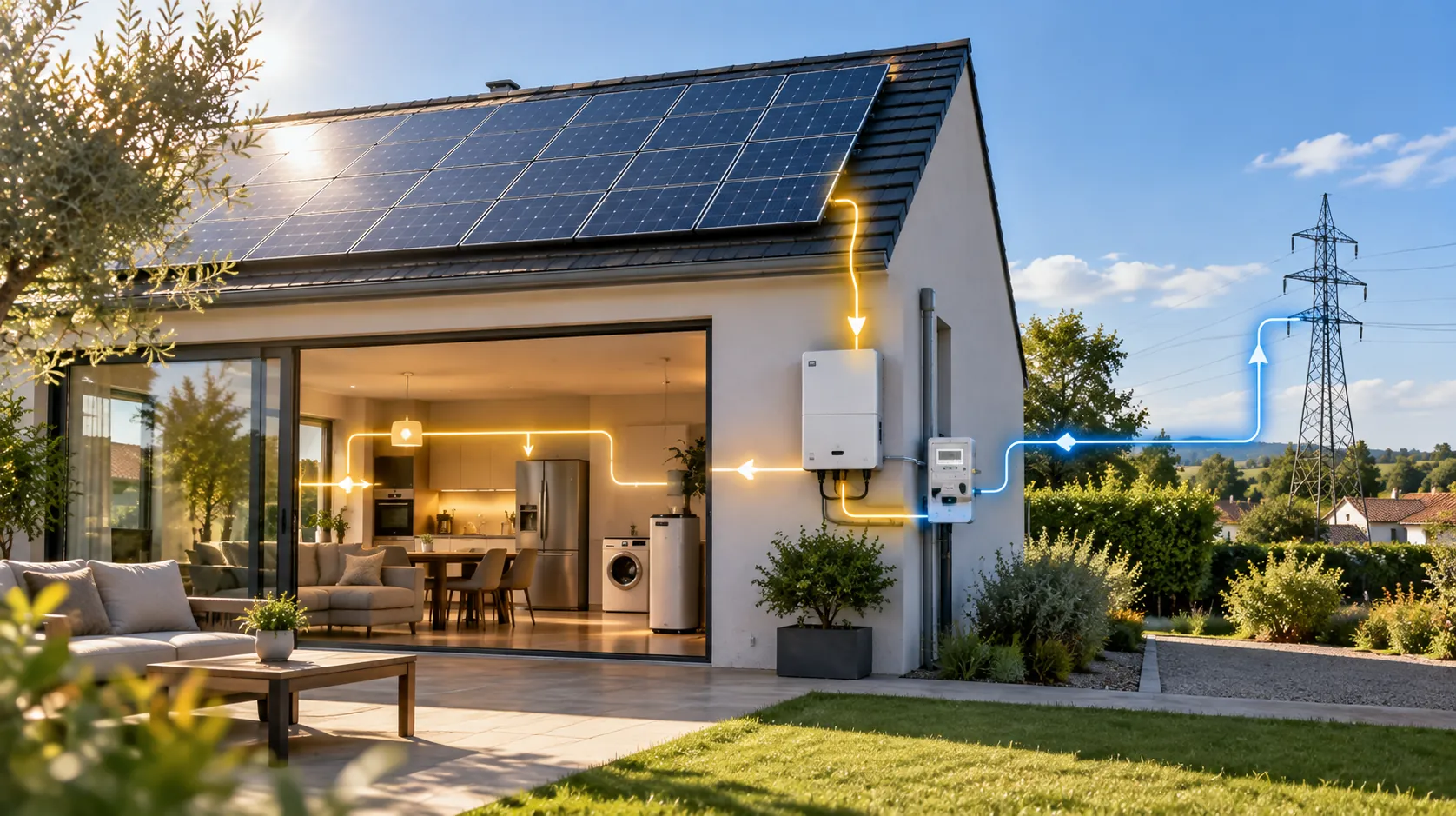
The SigenStor is not just another battery to connect alongside your inverter. It is a single unit that performs five functions at once — what Sigenergy calls the “5-in-1” architecture. Here is what it combines:
- The photovoltaic inverter, which converts the direct current from the panels into usable alternating current.
- The PCS (power conversion system), which controls exchanges between the battery, the grid and the home.
- The battery using lithium iron phosphate (LFP) chemistry, stackable by module.
- The DC charger for electric vehicles, natively integrated.
- The EMS (energy management system), controlled via the mySigen app.
In practical terms, instead of combining an inverter, a battery and a wallbox from three different manufacturers — each with its own warranty, installer and app — you install a single product covered by a single manufacturer. This explains the attention surrounding the brand.
LFP chemistry: safety and longevity
The battery uses lithium iron phosphate (LFP) chemistry. The benefit is not merely marketing: unlike older NMC batteries, this chemistry does not undergo thermal runaway. The system operates from −20 °C to +55 °C and has an IP66 rating — in other words, you can install it outdoors without any makeshift solution, even in the coldest regions of France.
What about its service life? Sigenergy announces more than 6,000 cycles, equivalent to around fifteen years of daily residential use. The system warranty covers 10 years.
The SigenStor range: 5, 6, 8, 9 kWh and more
The SigenStor’s real advantage is not a fixed capacity, but its modularity. You build your energy storage system by stacking modules in increments of approximately 5 kWh. You can start small today and expand in two years — without replacing the inverter.
| Configuration | Battery capacity | Inverter power | Household profile |
|---|---|---|---|
| Entry-level | 5 to 6 kWh | 3 to 5 kW single-phase | Apartment, small house, moderate consumption |
| Mid-range | 8 to 10 kWh | 6 kW single-phase | Family home with high self-consumption |
| High-end | 12 kWh and more | 6 kW single-phase / up to 25 kW three-phase | Large house, heat pump, electric vehicle |
As for the inverter, the range covers 3.0 to 6.0 kW single-phase and 5.0 to 25.0 kW three-phase. The battery itself can reach several dozen kWh per installation, module by module.
At KitSolaire, two ready-to-install all-in-one configurations clearly demonstrate this approach:
- The SigenStor 6 kW single-phase all-in-one Solar Kit, designed for a family home, with an expandable battery from 5 to 54 kWh.
- A 9 kW single-phase configuration with an approximately 9 to 10 kWh Sigenergy battery, for households with high consumption — with a heat pump or electric vehicle in the mix.
To view all the configurations, the plug and play batteries category brings together the store’s energy storage solutions.
SigenStor price: what to expect in 2026
This is the key question, and the honest answer is not a single figure. The price of a SigenStor depends on three variables — which is why a search for “Sigenergy price” never gives you a straightforward amount.
- The power of the integrated inverter: 3 kW, 6 kW or more for three-phase systems.
- The number of stacked battery modules, and therefore the total capacity in kWh.
- The options: number of panels included, mounting kit and vehicle charging function.
To give you an approximate idea of the European market in 2026: configurations start at around €6,000 excl. VAT for a capacity of approximately 8 kWh, and rise to €12,000 excl. VAT and more once you exceed 20 kWh. These are not fixed catalogue prices — because the battery is modular, the quote matches the exact configuration.
Good to know: for KitSolaire’s SigenStor all-in-one solar kits, the price is provided by quotation, because each installation is custom-sized (power, capacity and number of panels). You only pay for what your household actually needs.
Why the all-in-one price is often more accurate
Comparing a SigenStor with a simple battery priced per kWh means missing the bigger picture. The price includes the hybrid inverter, electric vehicle charger and EMS — components that you would otherwise purchase separately with a conventional solution. When compared with the cost of a complete system (inverter + battery + wallbox + control system), the SigenStor’s entry price becomes significantly more competitive.
Which SigenStor model should you choose for your consumption?
The right model does not depend on the brand of your panels or the largest figure in the table. It depends on your consumption profile. Here is the method, in three steps.
Step 1: estimate your daily consumption
Take your annual consumption from your bill and divide it by 365. An average French household uses between 12 and 18 kWh per day — more with electric heating or a heat pump.
Step 2: choose the battery capacity
The rule is simple: a battery should cover what you consume in the evening and at night, when the panels are no longer producing.
- 5 to 6 kWh: moderate household consumption, with no major electrical loads in the evening. The right first step towards self-consumption.
- 8 to 10 kWh: family home, induction hob, household appliances and LED lighting. The most versatile capacity.
- 12 kWh and more: large house, heat pump or electric vehicle charging at night.
The 9 kWh Sigenergy battery option
The 9 kWh Sigenergy battery appears repeatedly in searches, and this is no coincidence: it is a very well-balanced capacity. Thanks to the SigenStor’s modular design, you can reach a configuration close to 9 to 10 kWh by stacking two modules of approximately 5 kWh. This capacity comfortably covers the evening and night-time consumption of a family home — induction hob, household appliances, lighting and standby loads — while leaving room to add an electric vehicle later. It is the balance point many people aim for first, before considering 12 kWh or more.
Step 3: choose the inverter power
The inverter must be able to handle your panels’ production while powering your appliances at the same time.
- 3 to 5 kW single-phase: suitable for most residential installations.
- 6 kW single-phase: the standard choice for an equipped family home.
- Three-phase up to 25 kW: for large properties or existing three-phase connections.
Are you still hesitating between an all-in-one battery and a simpler solar kit? The Sigenergy 3000W plug and play solar kit is an excellent entry point into the brand’s ecosystem, before increasing capacity.
Electric vehicle charging and smart features
Where the SigenStor stands out is its DC charging for electric vehicles, integrated as standard — no wallbox to add. The system also supports V2H (vehicle-to-home) and V2G (vehicle-to-grid) for compatible vehicles: your car can send energy back to the home or the grid.
The mySigen app controls everything: real-time production monitoring, optimisation based on time-of-use tariffs and artificial intelligence management to maximise self-consumption. In short, the system learns your habits and automatically balances energy storage, immediate consumption and surplus injection.
Government incentives and taxation in 2026
The regulatory framework is changing quickly. Here is what you need to know, updated for 2026. As these amounts change every quarter, always check the applicable figures at the time of your project on service-public.fr.
The self-consumption incentive
For a self-consumption installation with surplus injection, EDF Obligation d'Achat pays a self-consumption incentive. In the second quarter of 2026, it amounts to approximately €80/kWp for installations up to 9 kWp. It is paid in a single instalment, and its scale is revised periodically.
The reduced 5.5% VAT rate
Since 1 January 2026, the 5.5% VAT rate has applied to photovoltaic installations of 9 kWp or less, subject to conditions: a home that is more than two years old, panels with a low carbon footprint and an energy management system (EMS). Since the SigenStor includes an EMS as standard, this technical criterion is met. Above 9 kWp, the standard rate applies.
Important note about the battery: in 2026, there is no specific national incentive to finance an energy storage battery, and VAT on the storage component generally remains at 20%. The government considers the grid to act as a “virtual battery” through surplus injection. To accurately calculate the portion eligible for the reduced VAT rate, contact a certified installer.
The surplus feed-in tariff
Electricity that you produce without consuming it can be sold to EDF OA under a 20-year contract. For installations up to 9 kWp, the surplus feed-in tariff in 2026 is approximately a few euro cents per kWh. This income contributes to profitability, but do not lose sight of the priority: the main benefit of a battery such as the SigenStor is not selling energy, but self-consumption. Consuming your own energy always costs less than selling it and then buying it back.
Who is the SigenStor the right choice for?
The SigenStor is primarily aimed at households looking for a durable, scalable solution that is ready to support the electrification of their energy use.
It is the right choice if:
- you are aiming for high self-consumption and gradual energy independence from the grid;
- you have or are planning an electric vehicle and want to combine the inverter and charger;
- you plan to increase your storage capacity over time without replacing everything;
- you value LFP safety and a single manufacturer warranty covering the entire system.
It is less suitable if your needs are limited to supplementary solar production without storage: in that case, a simpler plug and play kit will be sufficient, with the option to upgrade to an all-in-one solution later.
In summary
The SigenStor is not just another battery: it is a modular 5-in-1 system, featuring safe and durable LFP chemistry, native electric vehicle compatibility and a range extending from 5 to more than 50 kWh. Its price, provided by quotation, follows this custom approach — and remains competitive when compared with an assembly of separate components.
The right model is the one that matches your actual consumption, not the largest or cheapest one. Calculate your evening consumption, as this is what determines the required capacity. To compare configurations, browse the SigenStor all-in-one category, explore the plug and play batteries or get started with the Sigenergy 3000W solar kit.