Français
You have had an installation quoted and the quotation comes to several thousand euros. This is usually when you start wondering what the state actually reimburses — and come across a jumble of bonuses, feed-in tariffs and VAT rates that do not all apply to the same project.
Sorting it all out is not that complicated. In 2026, state aid for solar panels rests on three pillars: the self-consumption bonus, the feed-in tariff for surplus electricity, and reduced VAT. MaPrimeRénov' and local aid may sometimes be added, but these are special cases. We review each scheme one by one: who is eligible, how much you can receive, and the order in which to complete the necessary steps.
Key takeaway: the amounts quoted correspond to the scales published by the Energy Regulation Commission (CRE), provided as a reference framework. They are revised every quarter. Always check the value in force on the date of your grid connection application on service-public.fr or with your installer before signing a quote.
Informational content updated at the end of May 2026.
Overview of solar aid in 2026
The first thing to understand is that these schemes do not target the same installations or the same customer profiles. Confusing them means applying for the wrong bonus.
| Scheme | Who is it for? | Type of benefit |
|---|---|---|
| Self-consumption bonus | Self-consumption with surplus injection, on a roof | Investment bonus (in €/kWp) |
| Surplus feed-in tariff (purchase obligation) | Self-consumption with surplus injection | Guaranteed income from injected electricity |
| Reduced VAT rate | Small residential installations | Reduced installation price |
| MaPrimeRénov' | Eligible energy-efficiency renovation work | Renovation aid (rarely PV) |
| Local aid | Depending on the region, département or municipality | Additional grants |
For residential photovoltaics, these are not five equally important forms of aid. The two that really matter are the self-consumption bonus and the feed-in tariff. MaPrimeRénov' primarily targets insulation and heating — it only applies to solar in specific cases, which we explain below.
The self-consumption bonus in 2026
What is it actually for?
The self-consumption bonus (its official name is “investment bonus”) is paid to individuals who install panels to consume their own electricity while injecting what they do not use into the grid. It is the form of aid most directly linked to purchasing a residential photovoltaic system.
It never comes alone. You sign a surplus injection contract with an approved buyer — EDF Obligation d'Achat or another supplier — and this contract gives you access both to the bonus and to a guaranteed tariff for the electricity you inject into the grid.
How much can you receive in 2026?
The amount of the 2026 self-consumption bonus depends on the rated power of your installation, expressed in kilowatt-peak (kWp). It is calculated in euros per kWp installed, and the CRE revises it every quarter according to the volume of connected installations. What fixes the scale for the entire duration of your contract is the date of the complete grid connection application (DCR) — not the date you sign the quote and not the installation date.
Here is something almost everyone gets backwards: the rate per kWp is not degressive. For the second quarter of 2026 (from 1 April to 30 June 2026), the reference amounts published by the CRE are as follows:
| Installation power | Bonus amount |
|---|---|
| ≤ 9 kWp | 80 €/kWp (up to 720 € for 9 kWp) |
| 9 to 36 kWp | 120 €/kWp |
| 36 to 100 kWp | 60 €/kWp |
Read the second line carefully. The 9–36 kWp bracket pays 120 €/kWp, which is more than the 80 €/kWp for the small residential bracket. The assumption that “the larger the installation, the lower the bonus per kWp” is therefore wrong here: the intermediate bracket is the best paid.
As for payment, do not expect a cheque on the day your system is commissioned. The payment terms vary according to power:
- for installations ≤ 9 kWp, the bonus is paid in a single instalment, approximately one year after commissioning (on the first anniversary of the grid connection) and appears on your first invoice from the purchase-obligation buyer — it does not arrive on the commissioning date;
- for installations > 9 kWp, payment is spread over five years: 80% in the first year, followed by 5% per year for four years.
As the scale is recalculated every quarter, these amounts apply until 30 June 2026. A figure found online in an old article is of no use to you: check the scale in force on the date of your complete grid connection application on service-public.fr or with your installer before signing.
Conditions to meet
To receive the bonus, several conditions must be met at the same time:
- the installation operates in self-consumption with surplus injection;
- the panels are installed on a roof — ground-mounted installations are generally excluded from the scheme;
- the installation meets the technical requirements, which means using an RGE-qualified installer (Recognised Environmental Guarantor);
- the bonus is paid by the purchase-obligation contract manager: in a single payment approximately one year after commissioning for an installation ≤ 9 kWp, and spread over five years above that threshold.
You may be thinking that a plug and play kit you connect yourself will do the job. Not when it comes to aid: these kits are not automatically entitled to the bonus or to a purchase-obligation contract. If your aim is to obtain state aid, a properly grid-connected installation carried out by a professional remains the safest route.
The surplus feed-in tariff (purchase obligation)
Alongside the bonus, the purchase obligation allows you to sell the electricity you produce without consuming it. The surplus is injected into the grid and purchased from you at a contractually guaranteed tariff for 20 years for photovoltaics.
Like the bonus, this feed-in tariff is revised every quarter by the CRE and depends on system power. Two things are worth keeping in mind:
- the tariff is guaranteed for the entire contract term from the date it is signed — this is what secures the project's long-term profitability;
- it is not the price at which you buy your own electricity. The point is therefore not to sell everything: it is to maximise self-consumption, then make the most of what remains.
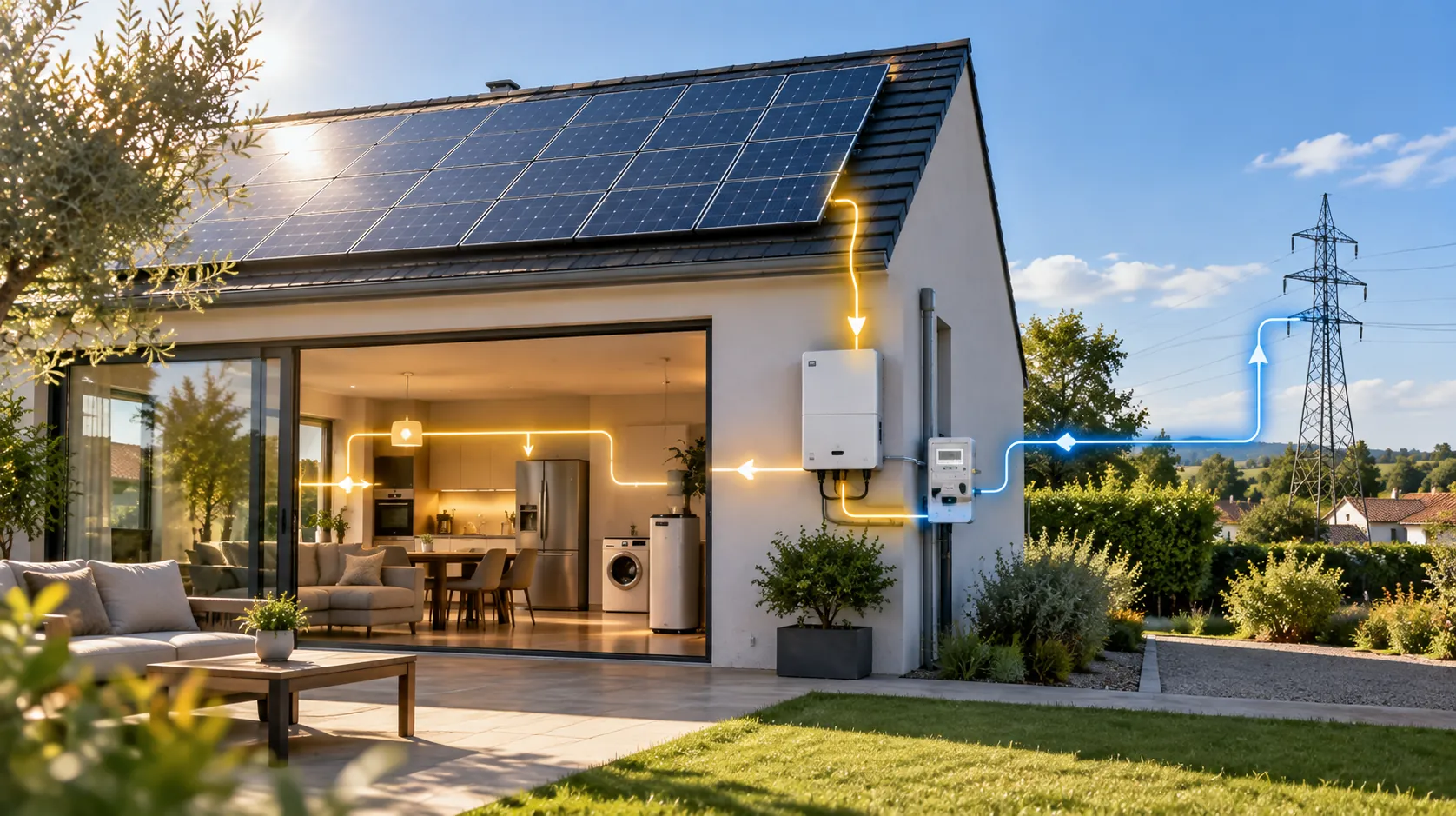
This is exactly where a battery changes the calculation. Without energy storage, electricity produced at midday when nobody is home is sent back to the grid at the feed-in tariff; in the evening, you buy your own electricity back at a higher price. A battery that stores energy during the day for use in the evening increases your self-consumption rate and reduces the amount of electricity you draw from the grid. All-in-one solutions such as the SigenStor by Sigenergy combine an inverter and battery to manage this balance between self-consumption and surplus injection.
Reduced VAT on solar panels
Of all the forms of aid, reduced VAT is the simplest: you do not need to take any action, as the installer applies the reduced rate directly to the invoice. It affects the installation price, and nothing more.
However, be careful: the rules have changed. Since the order of 8 September 2025, the following applies in 2026:
- residential photovoltaic installations up to 9 kWp may qualify for a reduced VAT rate of 5.5% (instead of the standard 20% rate), for supply and installation in the home, since 1 October 2025;
- the former 10% rate limited to 3 kWp has been abolished: on a transitional basis, it only remains available for projects started before 1 January 2026. For a new project in 2026, the threshold is no longer 3 kWp but 9 kWp;
- above 9 kWp, the standard rate of 20% applies again.
The 5.5% rate does not apply automatically either. The order sets out cumulative technical conditions: the modules' carbon footprint must be below the threshold of 530 kg CO2 eq/kWp, heavy-metal content must be very limited, an energy management system must be present, and the installer must hold a valid qualification. Not all equipment qualifies.
Photovoltaic taxation often changes. Before comparing two quotes, ask your installer for the exact VAT rate applied to your configuration and confirmation that the equipment complies with the reduced-rate criteria, have this written clearly on the quote, and cross-check the current information on service-public.fr.
MaPrimeRénov' and solar: what you need to know
This is the number-one source of confusion, so let us be clear. MaPrimeRénov' is the state's flagship scheme for the energy-efficiency renovation of homes. It primarily funds insulation, replacement heating systems (heat pumps, biomass boilers) and ventilation.
For solar, remember two things:
- standard photovoltaic panels that produce electricity are generally not covered by MaPrimeRénov'. For these systems, the dedicated schemes remain the self-consumption bonus and the feed-in tariff;
- some solar thermal technologies, on the other hand, are eligible: the individual solar water heater (CESI) and the combined solar system (SSC), which provide hot water or heating, qualify subject to the applicable criteria.
In other words, if you search for “MaPrimeRénov' solar panel” expecting to fund electricity-generating panels, you are looking for the wrong scheme: you need the self-consumption bonus. For solar hot water, however, check the MaPrimeRénov' conditions for CESI or SSC carefully.
Here again, scopes and scales change. The official portals maprimerenov.gouv.fr and service-public.fr are authoritative.
Local aid: a supplement not to overlook
Beyond national schemes, many local authorities — regions, départements, municipalities and intermunicipal bodies — offer their own solar grants. Their availability and amount vary considerably from one area to another: your neighbour in the next département may receive aid that is not available to you.
To find out what is available in your area:
- contact your town hall and regional council;
- speak to a France Rénov' adviser, the free public renovation information service, which can review the schemes that can be combined in your situation;
- above all, check whether schemes can be combined: some local aid can be added to the national bonus, while other schemes exclude it.
No national guide can list these schemes, precisely because they are local and changeable. The only way to find out is to ask locally: a call to your town hall or regional council may uncover a few hundred euros that no one will tell you about spontaneously.
How can you combine aid for a solar kit in 2026?
For a residential installation operating in self-consumption with surplus injection, the combination that maximises returns comprises four elements:
- the self-consumption bonus, paid under the purchase-obligation scheme;
- the surplus feed-in tariff, which generates a guaranteed income from injected electricity;
- reduced VAT on the installation, for eligible system powers;
- any local aid available in your area.
A few simple rules will help prevent your application from being rejected at the last minute and ensure you get the most from your solar kit aid in 2026:
- use an RGE-qualified installer when the aid requires one — this is often the condition on which everything else depends;
- keep all supporting documents: detailed quote, invoices, certificate of compliance and purchase-obligation contract;
- follow the correct order of procedures: for many schemes, the application must be submitted before work begins or at the time of grid connection;
- watch the thresholds: 9 kWp has become the key threshold (5.5% VAT, bonus paid in a single instalment and dedicated tariffs), while the bonus scale changes according to the bracket.
Which solar kits are eligible for aid?
The real criterion is not the panel brand. It is the installation configuration: self-consumption with surplus injection, roof mounting, compliant grid connection and, in most cases, work carried out by an RGE professional.
To qualify for state aid, choose self-consumption kits designed for grid connection with surplus management — not a simple kit to plug in for occasional supplementary power. You will find suitable configurations in our self-consumption solar kits category, designed to generate, self-consume and inject surplus electricity.
To go further and increase your self-consumption rate — and therefore profitability once aid has been deducted — combining your system with a battery is often decisive. All-in-one systems such as the SigenStor by Sigenergy integrate an inverter, energy management and energy storage: less equipment to coordinate, and better use of every kWh generated.
Frequently asked questions
What aid is available for solar panels in 2026?
The main forms of state aid for solar panels in 2026 are the self-consumption bonus, the surplus feed-in tariff (purchase obligation) and the reduced VAT rate for small installations. Local aid may also be available depending on your area. As the amounts are revised every quarter, check the current scales before submitting any application.
Does the self-consumption bonus still exist in 2026?
Yes, the 2026 self-consumption bonus remains the reference scheme for installations operating in self-consumption with surplus injection. Its amount, in euros per kWp, varies according to the power bracket — without being degressive, as the 9–36 kWp bracket is better paid per kWp than the ≤ 9 kWp bracket — and the CRE revises it every quarter. For an installation ≤ 9 kWp, the bonus is paid in a single instalment approximately one year after commissioning. Consult the official scale in force when you submit your grid connection application.
Does MaPrimeRénov' fund photovoltaic panels?
Generally speaking, no: photovoltaic panels that produce electricity are covered by the self-consumption bonus, not MaPrimeRénov'. The latter targets energy-efficiency renovation (insulation and heating) and may cover certain solar thermal solutions such as solar water heaters. Check the criteria on maprimerenov.gouv.fr.
What VAT rate applies to a solar panel?
Since 1 October 2025 (order of 8 September 2025), residential installations up to 9 kWp may qualify for a reduced VAT rate of 5.5% instead of the standard rate of 20%, subject to technical conditions (low module carbon footprint, energy management system and qualified installer). The former 10% rate limited to 3 kWp has been abolished for new projects. Have your installer confirm the exact rate and equipment eligibility, and consult service-public.fr.
In summary
In 2026, the essentials can be summed up in a few words: the self-consumption bonus and feed-in tariff secure grid-connected projects, 5.5% VAT reduces the cost of systems up to 9 kWp, and local aid may sometimes be added. MaPrimeRénov', meanwhile, remains focused on energy-efficiency renovation, not standard photovoltaics.
The rest is a matter of method: size and connect your system correctly, use a qualified professional when required, and check every current amount against official sources, since the scales change every quarter. Once the financing is clear, compare eligible configurations in our self-consumption solar kits category and consider a SigenStor energy storage system to make the most of every kilowatt-hour produced.
This article is provided for general informational purposes and does not constitute personalised tax or regulatory advice. Aid schemes, amounts and conditions change regularly. Before making any decision, check the current information with official sources (service-public.fr, maprimerenov.gouv.fr) or a France Rénov' adviser.