Français
Solar Battery for Your Home: A Guide to Making the Right Choice
Since the June 2026 reform, the battery has gone from being a comfort option to becoming the primary profitability driver for a solar installation. But what capacity should you choose? What format? At what price, and for what actual savings? This guide answers all these questions — without a line of technical jargon.
Why a Battery Changes the Calculation Completely in 2026
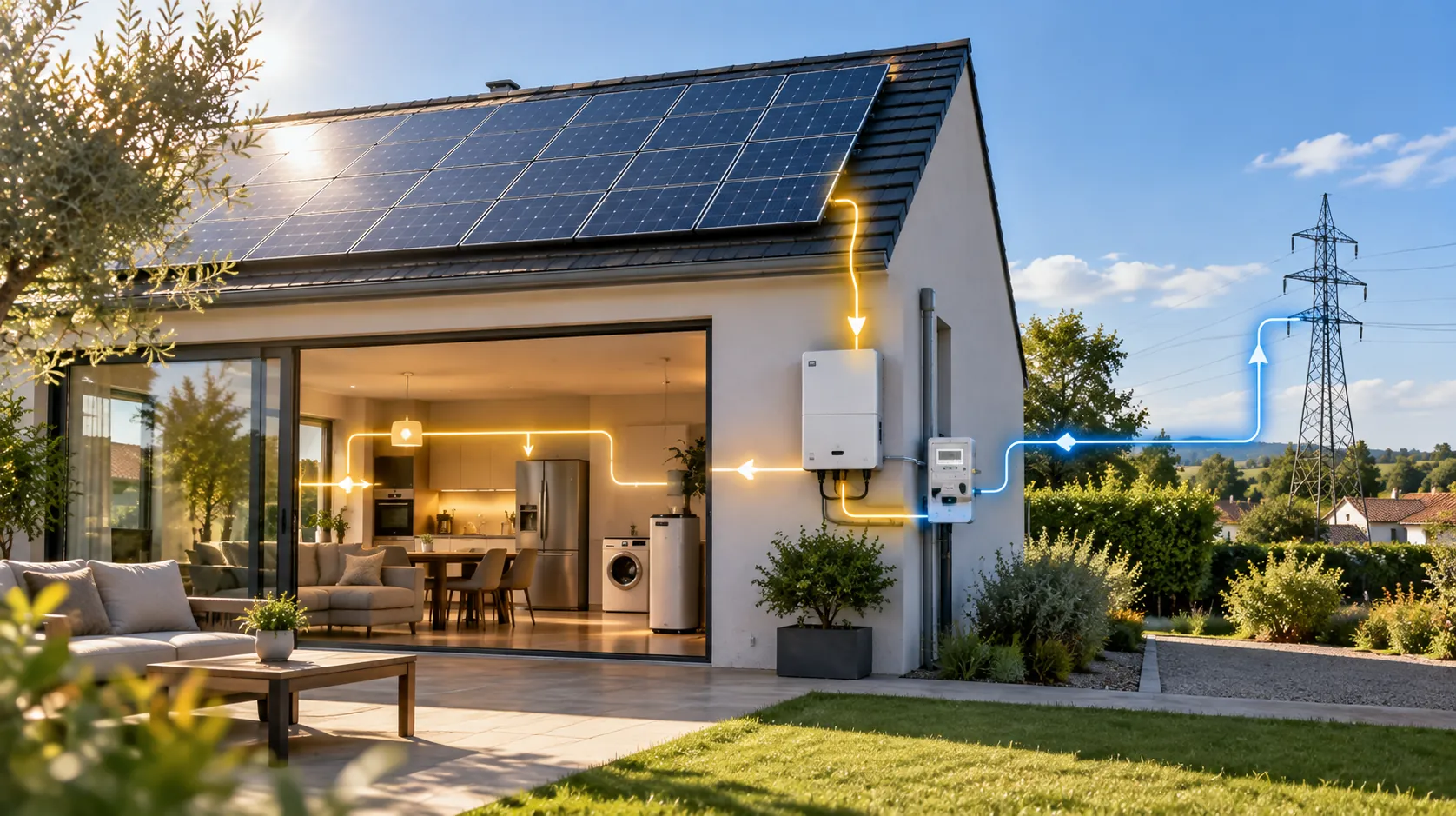
Let's start with the only thing you need to understand. Your panels produce mostly in the middle of the day. Your home, on the other hand, consumes mostly in the morning and evening. Without a battery, this mismatch has a direct consequence: a large part of your production is sent to the grid, where it is bought back from you at €0.011 per kWh. The same kWh, if you had consumed it at home, would have saved you from buying one from the grid at €0.1940 (Tarif Bleu, first half of 2026).
A kWh consumed at home is worth nearly 18 times more than a kWh sold back to the grid. ×18 That is precisely the role of the battery: moving your midday sunshine to your evening.
In practical terms, an installation without a battery typically self-consumes 40 to 50% of its production. With a correctly sized battery, this rate rises to 70 or 80%. For a 6 kWp installation in southern France, this difference represents approximately €460 in additional savings per year — more than €9,000 over 20 years. This difference is what pays for the battery, as we explain in detail in our guide to solar profitability in 2026.
How Does It Work? One Minute Is All You Need
A modern solar battery is a discreet unit, mounted on the wall or floor, in a garage or utility room. During the day, it absorbs the surplus your home does not use. In the evening, it automatically releases it: the oven, television and lights draw from the battery first before taking power from the grid. You do not need to control anything — everything happens automatically, and an app shows you in real time where your electricity comes from.
That is all you need to know about how it works. The rest — cell chemistry, charge cycles and discharge curves — is our job, not yours.
What Capacity Does Your Home Need? The Answer by Household Profile
Capacity is measured in kWh: it is the size of the tank. The right size depends on just one thing — what your household consumes between late afternoon and the following morning. Here are the three typical profiles:
| Your situation | Recommended capacity | What it covers |
|---|---|---|
| Couple or small household, away during the day | 5 kWh | The entire evening: cooking, TV, internet box, lighting and dishwasher during off-peak hours |
| Family, main residence, daily appliance use | 10 kWh | Evening + night + early morning: the most common profile |
| Large home, high consumption or electric vehicle | 15 kWh | Near-autonomy from evening to morning, including partial vehicle charging |
Two guidelines will help you avoid common mistakes. If it is too small, the battery is full by 2 p.m. and the rest of your production is sent back to the grid at 1 cent. If it is too large, it never fills completely and you have paid for storage capacity that is not used. That is why our assessments always start with your actual consumption — not the size of your roof.
One final guideline: we recommend staying at 15 kWh or less. Above this level, French regulations require specific adaptations that increase the budget without providing a proportional benefit for a household. Our configurations comply with this threshold as standard — you do not need to check anything.
The Three Battery Formats: Which One Suits You?
1. A battery coupled to your installation. The classic format for a roof-mounted installation: the battery works with your panels' inverter and supplies power to the entire home. This is the most powerful and scalable solution — the one we install in our turnkey offers, where it arrives correctly sized, installed and commissioned.
2. The all-in-one system. The battery and electronics are combined in one compact, stylish unit controlled by an app. Fewer elements on the wall, faster installation and a refined appearance. The SigenStor, which we distribute, is the most advanced example in this category: modular, it grows with your needs as you stack modules.
3. The plug & play battery. For kits that plug into a socket: a small battery (1 to 4 kWh) connects directly to your balcony or terrace kit, without an electrician. It is not the same scale, but the same principle: consume your sunshine in the evening. Discover our range in the plug & play batteries section.
Do You Definitely Need a Battery? No — Here Are the Situations Where We Will Tell You Not to Buy One
Honest advice is better than one more sale. There are situations where a battery is not the right choice today:
If you are at home during the day and consume electricity as it is produced (working from home, retired or running a heat pump during the day), your self-consumption rate is already naturally high — a battery would add little. If your budget forces you to choose between correctly sized panels and a battery, choose the panels first: a battery can easily be added later. And if your evening consumption is very low, the calculation simply will not work.
In all other cases — and this is the majority of households since the reform — the battery has become the most profitable investment in the installation.
How Much Does It Cost, and How Long Does Payback Take?
Prices have fallen significantly over the past three years. In 2026, allow approximately: €2,000 to €3,500 for 5 kWh, €3,500 to €6,000 for 10 kWh, and €5,500 to €8,500 for 15 kWh, including installation depending on the configuration. The all-in-one system is at the upper end of the range, offset by a simpler installation.
Regarding the return on investment: using our example of a 6 kWp installation in the south, the 10 kWh battery generates approximately €460 in additional savings per year. At €4,500 installed, it pays for itself in around ten years — for a service life that extends well beyond this point.
Service Life and Warranties: What to Expect
Today's batteries use lithium iron phosphate (LFP) technology: stable, safe and durable. In practical terms, a battery used every day will operate for 15 to 20 years, and reputable manufacturers provide a warranty of 10 years or more. For comparison, this is in the same order of magnitude as your panels themselves. Capacity decreases very gradually over the years — like that of a phone, but much more slowly.
What Happens in the Event of a Power Cut?
This is the question everyone asks, and the answer needs to be precise: it depends on the configuration. Some batteries automatically switch to backup mode and keep your essential circuits running — refrigerator, internet box and lighting — for several hours. Others, particularly plug & play systems, shut down with the grid for safety reasons. If backup power is important to you, mention it during the assessment: it is a selection criterion, not an option that can be added afterwards.
Which battery suits your actual consumption? Let's check together.
Request my free assessment Talk to an expert (30 min, free)Frequently Asked Questions
Can I add a battery to my existing panels?
In the vast majority of cases, yes — even if your installation dates back several years. The technical solution depends on your current equipment, but there are now batteries compatible with practically every configuration. A quick assessment is enough to confirm this.
What is the best capacity for a family of 4?
Most often 10 kWh: this is the format that covers the evening, night and early morning for a typical family household. But the real answer depends on your actual consumption — that is precisely what the free assessment measures.
Does a battery work in winter?
Yes. Installed indoors (garage, utility room), it is not exposed to the cold. It fills more slowly in winter simply because your panels produce less — but every stored kWh retains exactly the same value on your electricity bill.
Does the battery require maintenance?
No maintenance is required on your part. The system manages its charge cycles automatically, and the app alerts you if anything requires attention. It is a piece of equipment you can forget about — in the best possible sense.
Physical battery or virtual battery?
A virtual battery is a subscription service that “stores” your surplus on paper; a physical battery stores your kWh at home, without a subscription or feed-in conditions. Since the 2026 reform, the calculation clearly favours physical storage for most households — we will be publishing a detailed comparison dedicated to this topic.
Data: EDF Tarif Bleu, 6 kVA Base option, first half of 2026 (€0.1940/kWh incl. VAT); surplus feed-in tariff 1.1 c€/kWh excl. VAT (order applicable on 5 June 2026). Battery prices are approximate and exclude promotions — the exact price depends on the configuration of your installation. Article updated in July 2026.