Français
You have probably already typed “6000W solar kit” into a comparison tool, only to come away with ten configurations that look identical in the photos but vary in price by as much as twofold. Central or hybrid inverter, with or without a battery, single-phase or three-phase: behind the same 6000-watt figure lie installations with different uses, efficiency levels and returns on investment.
This guide will not explain self-consumption all over again. It will answer the only question that really determines your purchase: is a 6000W self-consumption solar kit suitable for your household, and if so, which one?
We start with your consumption, not the datasheet. This is the only way to avoid paying for kWh that you will see exported to the grid at a low price.
Key takeaway: the amounts of photovoltaic subsidies (self-consumption bonus, surplus feed-in tariff, VAT rate) are revised regularly, often every quarter. Always check the applicable schedule on the date of your quote at service-public.fr or with your installer.
6000W, 6 kW, 6 kWp: we are talking about the same thing
Before going any further, let us clear up the ambiguity that makes half of buyers hesitate. When a seller displays a 6000W solar kit, 6kW solar kit or 6 kWp solar kit, they mean the same installation: a peak production power of approximately 6 kilowatts, meaning the maximum power delivered under standard sunlight conditions.
The “W” and “kW” measure the same quantity; the “p” in kWp simply indicates that we are referring to peak power. So there is no catch. Three ways of writing it, one figure.
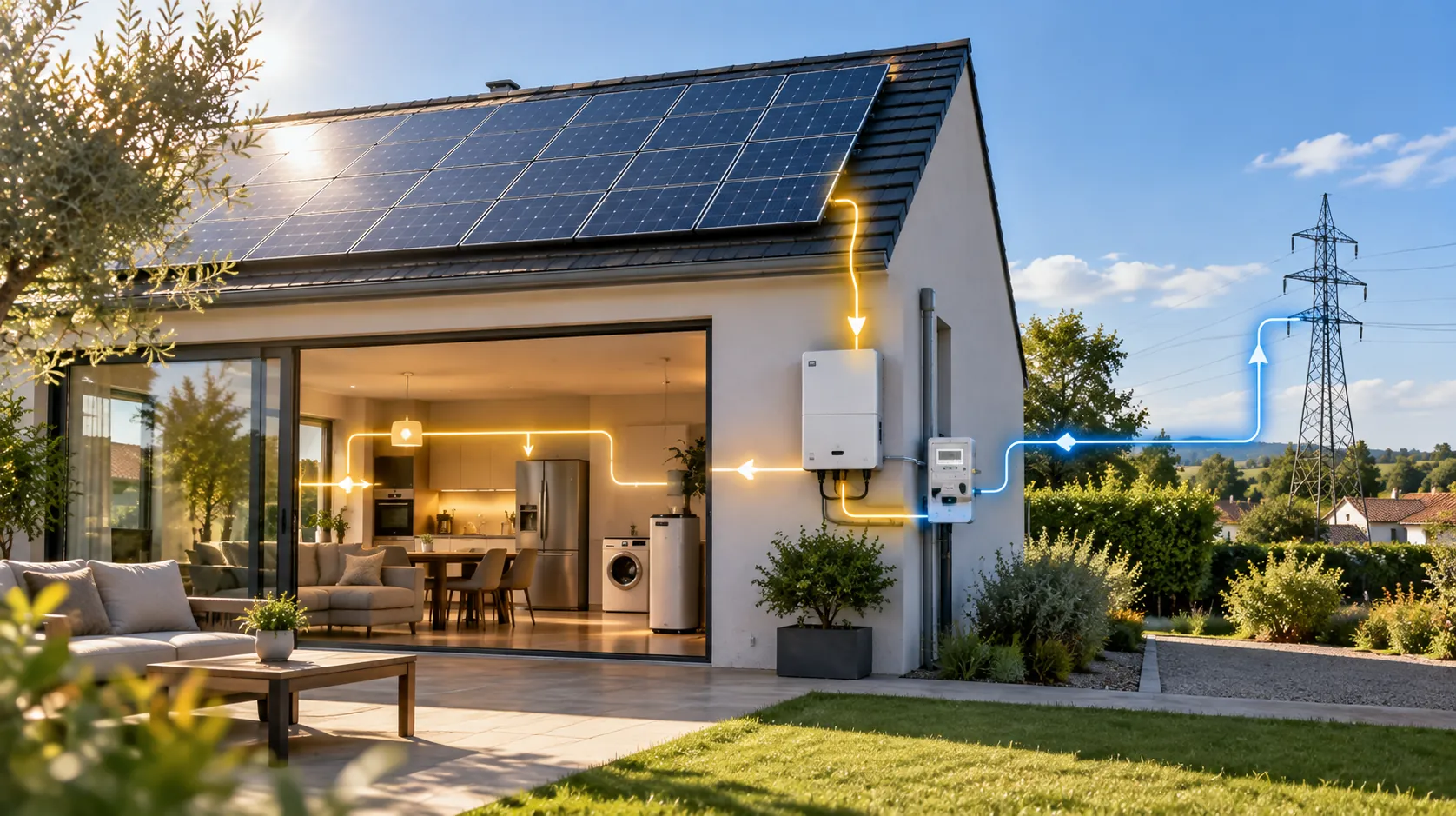
In practical terms, a 6000W self-consumption kit generally consists of 12 to 14 panels rated at 450 to 500 Wp, covering 24 to 30 m² of well-oriented roof space. This is the approximate scale to keep in mind when looking at your roof section.
Who is 6000W the right step for?
This is the heart of the matter. 6 kWp is not a “default” power rating. It is the balance point for a specific consumption profile.
The typical profile: around 6000 kWh per year
A 6 kWp kit produces between 6,000 and 8,000 kWh per year in metropolitan France, depending on your region, roof orientation and pitch (as a general guideline, 900 to 1,400 kWh per kWp per year are observed in residential operation). Production is higher in the South-East and more moderate in the northern half.
Compare this figure with your electricity bill. 6000W is the right choice if your annual consumption is around 6,000 kWh, which corresponds to a family home that is beginning to combine several loads: electric supplementary heating, a hot-water tank, household appliances and perhaps a first electric vehicle charging station.
For reference, a French household without electric heating commonly consumes 4,000 to 5,000 kWh per year. As soon as a major load is added — a thermodynamic water heater, reversible air conditioning or full-time remote working — consumption rises towards 6,000 kWh, and 3 kWp becomes too limited.
When to aim lower and when to aim higher
Let us be practical about the limits.
- Below 4,000 kWh/year with consumption mainly in the evening: a 6000W system will produce surplus electricity that you will inject into the grid at a low price. A more compact format will be sufficient.
- Above 8,000 or even 10,000 kWh/year, with a heat pump and an electric car charged at home: 6 kWp becomes somewhat limiting. You should then genuinely compare power ratings to avoid unnecessary oversizing.
The 6000W self-consumption kit occupies the comfortable middle ground: powerful enough to cover most of the needs of a high-consuming household, without the additional cost of a 9 kWp system whose electricity would largely be exported to the grid.
A share of your consumption during the day
This is something many people overlook. A 6 kWp kit is only worth its price if you consume electricity when it produces it, meaning in the middle of the day. The real criterion is not the displayed power rating. It is the time at which your appliances operate.
Working from home, a hot-water tank controlled during solar hours, washing machines and dishwashers scheduled for the afternoon: the more your consumption overlaps with production, the higher your self-consumption rate will be. And it is this rate, not the raw power rating, that determines profitability. If the house is empty all day and everything is switched on at 7 p.m., keep this question in mind — we answer it just below with the battery.
With or without a battery: the question that changes everything
This is the most important decision for your 6000W solar kit, far more so than the brand of the panels.
Without energy storage, a household self-consumes around 30 to 40% of its production. The rest is sent to the grid and purchased at a deliberately low tariff. With a correctly sized battery, this rate often exceeds 70%. The same sunlight, but used twice as effectively: what you would have sold cheaply in the afternoon becomes electricity you would otherwise have bought back in the evening.
When a 6000W system without a battery is sufficient
You may think that a battery is necessarily the right choice. Not so fast. A 6000W system without a battery remains relevant if:
- a significant share of your consumption takes place during the day;
- you first want to control your budget and payback period;
- you plan to add energy storage later, once your electricity bill has been reduced.
For this profile, a production-only kit already maximises your savings. Our HYXiPOWER 6000W professional self-consumption solar kit perfectly illustrates this approach: a 6 kWp configuration designed to produce and last, without paying upfront for a battery that you would not immediately use.
When the battery becomes decisive
Conversely, if you mainly consume electricity in the evening and at night — returning from work, cooking or charging an electric car after 7 p.m. — the calculation changes. In this case, energy storage is no longer a luxury; it is the lever that makes your panels profitable.
An integrated hybrid inverter + battery solution avoids the complexity of manually assembled components. Our Huawei 6000W professional solar kit with 10 kWh energy storage meets this need: 6 kWp of production coupled with 10 kWh of energy storage, enough to shift a significant share of afternoon production into the evening.
A practical guideline: for 6 kWp, a capacity of 6 to 10 kWh suits typical residential use. Below this level, the battery reaches full capacity in summer and surplus electricity is sent to the grid. Above it, the additional cost takes longer to pay back if your evening consumption remains moderate. You will find other formats in our plug-and-play batteries category.
Single-phase or three-phase: choose the right connection
This is a question that is often discovered too late and can block an installation. Your home is connected either as single-phase or three-phase — this is shown on your electricity bill and electrical panel.
For a 6000W self-consumption solar kit, both cases exist:
- Single-phase: this is the connection used by the vast majority of French detached houses. A 6 kVA single-phase inverter can inject electricity without difficulty. This is the standard case.
- Three-phase: common when there is a powerful heat pump, a fast charging station, a workshop or energy-intensive equipment. The kit must then include a three-phase inverter to distribute production across the three phases.
The rule is simple: the kit must match your home's connection type. A single-phase inverter cannot be connected to a three-phase installation without adaptation. Before ordering, identify your connection type on your electricity bill — it is the quickest information to verify and the one most often overlooked.
Efficiency: what really makes a 6 kWp system produce
There is a lot of discussion about panel power. But at a displayed rating of 6000W, two installations can differ in annual production by 15 to 20%. Actual efficiency cannot be read from the label.
Three factors have the greatest impact, in this order:
- Orientation and pitch. Due south with a 30-35° pitch is optimal in France. An east-west orientation reduces yield by 10 to 20%, but spreads production throughout the day — which can also improve your self-consumption rate.
- Shading. A chimney, tree or adjacent roof section: partial shade on a few panels can reduce the production of an entire string. Microinverters or optimisers limit this loss.
- Inverter quality. This is the core that converts the panels' direct current into usable alternating current. An inverter correctly sized for 6 kWp, with good conversion efficiency, makes a difference over twenty years.
Actual efficiency is therefore not the figure on the panel datasheet. It is the combination of roof + inverter + absence of shading. An unshaded 6 kWp system facing due south will significantly outperform a poorly oriented 6 kWp system with the same equipment.
Return on investment: let us do the calculation
This is the question that will really determine your decision. How long does it take to pay back a 6000W self-consumption kit?
Rather than making a promise, here is how it works. Three variables control everything:
- Your electricity purchase price per kWh. Each kilowatt-hour you self-consume saves you the full price charged by your supplier. The higher this price — it rose sharply between 2022 and 2024 — the faster the payback.
- Your self-consumption rate. A 6 kWp system with a self-consumption rate of 70-80% generates far more savings than the same kit with half its production exported to the grid. Surplus injection is paid at a tariff well below the purchase price.
- The kit's initial cost. Panels, inverter, optional battery and installation. This is the cost reduced by subsidies.
Let us establish an approximate figure. A 6 kWp system producing 7,000 kWh/year, with a self-consumption rate of 70%, means nearly 4,900 kWh per year that you no longer have to buy from your supplier. At the current electricity price, the annual saving amounts to several hundred euros — and increases with every tariff rise. The remainder, the surplus, is sold under a purchase obligation contract.
The real key to a good return is not the most powerful or cheapest kit. It is the match between production and your actual consumption. Oversizing for surplus injection is rarely the right calculation today.
2026 subsidies: the framework, not outdated amounts
Schemes change frequently, and an amount found online six months ago is probably already incorrect. Here is how each subsidy works for a 6 kWp system, without giving you a figure that will be outdated tomorrow.
The self-consumption bonus. Paid for a self-consumption installation with surplus injection, connected under a purchase obligation contract. It is expressed in euros per kWp, its amount decreases according to power, and the schedule is revised periodically. A 6 kWp system remains below the residential threshold of 9 kWp, which qualifies for the most accessible conditions. The applicable amount is the one in force on the date of your connection application — check it against the current schedule rather than relying on an old figure.
Reduced VAT. Low-power residential photovoltaic systems may qualify for a reduced VAT rate compared with the standard rate of 20%, subject to power, installation by a qualified professional and connection conditions. At 6 kWp, you remain below the favourable threshold. As thresholds and rates are adjusted through finance legislation, ask your installer to confirm the exact rate in writing on the quote.
Surplus feed-in. Unconsumed surplus can be sold under the purchase obligation scheme at a tariff guaranteed by a long-term contract — around 20 years for photovoltaics. This tariff is revised periodically and remains deliberately lower than your purchase price. This is not a drawback: it signals that the economic priority is direct self-consumption.
For details of these schemes, also see our guide to French government subsidies for solar in 2026.
Which 6000W solar kit should you choose?
Everything depends on your hourly profile. Two uses, two configurations.
You mainly consume during the day: the 6000W production system
If a significant share of your consumption takes place when the sun is shining, or if you want to start without the additional cost of a battery, choose a production-only kit. Our HYXiPOWER 6000W professional self-consumption solar kit is designed for this profile: 6 kWp optimised for efficiency, a configuration you will not need to redesign in five years, and the option to add energy storage later.
You mainly consume in the evening: the 6000W system with energy storage
If you use most of your electricity after sunset — car charging, cooking or evening electric heating — energy storage becomes the lever that makes your panels profitable. Our Huawei 6000W professional solar kit with 10 kWh energy storage couples 6 kWp with a 10 kWh battery, shifting afternoon production into the evening and pushing your self-consumption rate well beyond 70%.
The right step before ordering
Whatever the model, check three things in this order: your annual consumption (on your bills), your hourly profile (day or evening) and your connection type (single-phase or three-phase). These three figures determine the choice better than any datasheet.
The right 6000W kit is the one that matches your consumption
There is no single best 6000W self-consumption solar kit. For most households consuming around 6,000 kWh per year, 6 kWp is the most balanced step: powerful enough to cover most needs, below the 9 kWp threshold that provides access to the most favourable conditions, without the loss-making surplus injection of an oversized kit.
The process takes three steps: size the system based on your bills, choose a battery or not according to your hourly profile, and check your connection. Do not chase power. To compare 6000W configurations side by side, with and without energy storage, browse our self-consumption solar kits.
References
- service-public.fr — Subsidies for installing solar panels
- ADEME — Photovoltaics for households
- EDF — Solar solutions and self-consumption
This article is provided for general information purposes. Subsidy schemes, amounts and conditions change regularly. Before making any decision, check the current information with official sources or a France Rénov' adviser.